
Four cricket bowling drills to identify your stock-ball misses
Use separate length and line targets to identify spin-bowling misses, then check your stock ball with a simple six-ball scorecard.
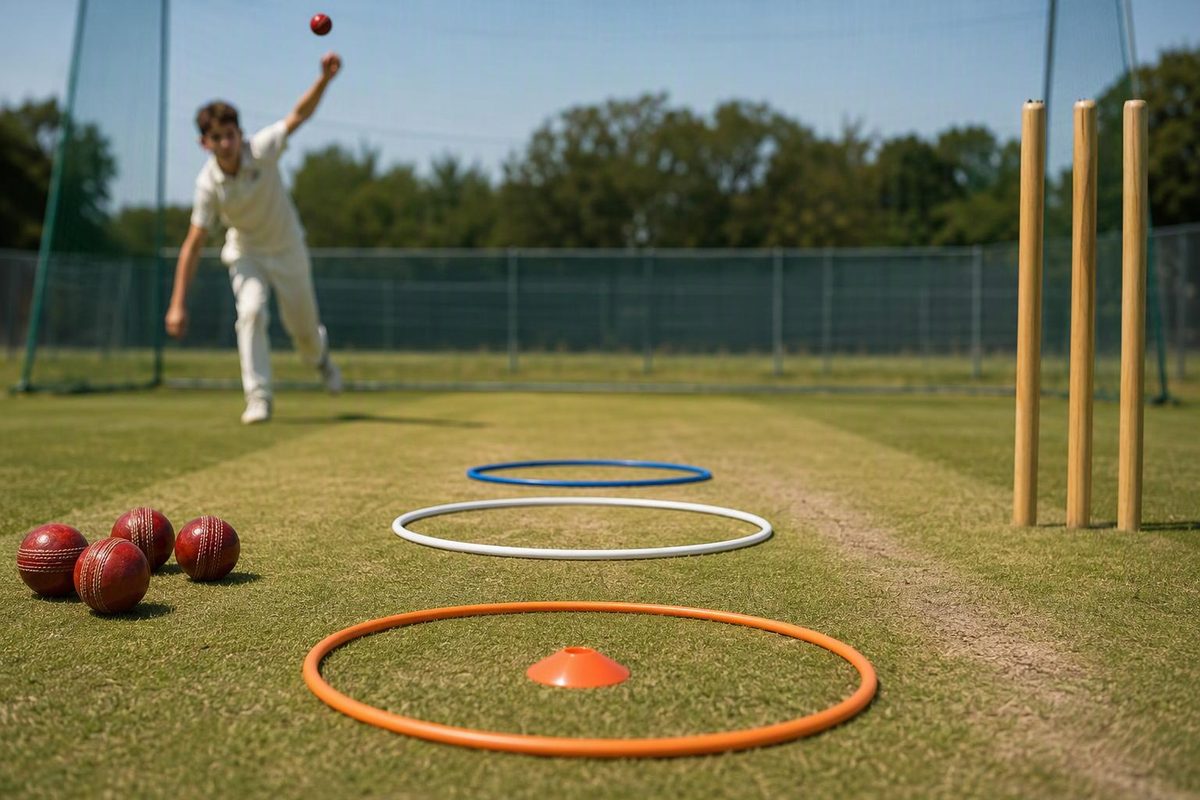
When your stock ball keeps missing its target, separate length—how far down the pitch it bounces—from line, its sideways position. These cricket bowling drills help you record the difference before changing your action.
Use one stock delivery throughout: your usual off-break or leg-break. Leave variations out. If you want a baseline-and-comparison session rather than separate diagnostic drills, use the stock-ball practice plan.
The counts and target sizes below are suggested practice settings, not established performance standards. Use fewer balls if that suits your age, workload or available time.
Set up a target you can measure
You need a ball suitable for your age group, a safe net or clear practice area, flat markers and a notebook. Use your usual match pitch length; juniors should use their competition’s distance rather than automatically practising on an adult pitch. Practise without a batter for these checks so you can concentrate on the first bounce.
After warming up and bowling a few easy deliveries:
- Mark a landing rectangle 1 metre long along the pitch and 60 centimetres wide. Use chalk where permitted or flat markers just outside its corners.
- Choose its position for the batter you are imagining. The target is where the ball first bounces, not where it reaches the stumps.
- Measure its distance from the batting crease so you can recreate it next time. Choose a useful length for your stock ball rather than treating one distance as correct for every spinner and surface.
- Keep markers clear of your feet and follow-through. Keep other people out of the delivery path, and stop if bowling causes sharp pain.
Pitchero’s Cricket Academy uses a mat as a landing target and counts hits within an over. These drills adapt that target-practice idea, using a marked area so the ball bounces on the actual surface.
1. Delivery-stride drill: check the release
Purpose: feel your spinning release without managing the whole approach.
Start in a comfortable delivery-stride position, aligned towards the target. Bowl through your action and follow through naturally. Do six deliveries, resetting between each one rather than rushing.
Choose one cue appropriate to your spin family:
- Finger-spin: feel your index and middle fingers working across the ball rather than simply pushing it forwards. The BBC’s off-spin guide describes these fingers producing spin, with the wrist and index finger involved at release. For right-arm grip detail, use the off-break grip guide.
- Wrist-spin: feel the bent ring finger working with the wrist through release. The BBC’s right-arm leg-spin guide identifies the third finger—your ring finger—as doing much of the work on the ball.
These are attention cues, not instructions to rebuild your action. Left-arm bowlers should use their usual stock-ball release, not copy right-arm rotation directions literally.
Record: after each ball, mark whether the release felt like your intended stock ball: yes, no or unsure. This is a feel check, not a spin-rate measurement.
Checkpoint: do not judge this drill mainly by target hits. Pitchero’s delivery-stride drill specifically warns that consistency is difficult without a run-up. If the position feels awkward, use a comfortable one-step delivery instead of forcing it.
2. Length-strip drill: widen the line target
Purpose: check whether you repeatedly land the ball too short or too full.
Extend the rectangle sideways into a strip 1 metre long and about 2 metres wide. Keep its distance from the batting crease unchanged. Bowl 12 stock balls from your normal approach, with your normal spinning intent.
Score each first bounce:
- H: inside the strip.
- S: short of it—closer to you.
- F: beyond it—closer to the batter.
- X: outside its side edges. Add S or F too if the bounce was also short or full.
- T: full toss; there was no bounce to score.
Do not move the strip after each miss.
Checkpoint: tally the short and full misses, including those marked X-S or X-F. A repeated miss gives you a specific pattern to investigate; alternating misses do not establish one simple release fault.
3. Line-lane drill: widen the length target
Purpose: check sideways control with more room for length error.
Replace the strip with a lane 60 centimetres wide and 3 metres long, centred on the original rectangle. Bowl 12 stock balls from the same approach.
Record whether the first bounce was inside the lane, left of it or right of it as viewed from the bowling end. Add a short/full note for balls beyond its ends, and record full tosses separately. Keep left/right labels consistent even when imagining a left-handed batter.
Checkpoint: look for a repeated sideways miss. If one appears, check your starting alignment and approach before changing the grip; the miss alone does not identify its cause. A rear-view recording may help you compare deliveries. Secure the camera outside the ball’s path, and use the footwork drill if your approach is visibly inconsistent.
4. Six-ball test: put line and length together
Restore the original 1-metre-by-60-centimetre rectangle. Bowl two six-ball blocks with a short pause between them. Use only your stock ball; do not rescue a poor block with a pushed delivery.
Record every attempt, including full tosses and obvious misses:
| Block | Target hits / 6 | Hits with normal spin intent / 6 | Main miss |
|---|---|---|---|
| First | |||
| Second |
Keep an overstepped delivery in the practice count, but mark it separately: a target hit does not make it match-ready. Normal spin intent remains a personal judgement, not proof that revolutions stayed unchanged.
Your next-session decision: repeat the length strip if short/full misses dominate, the line lane if sideways misses dominate, or the release check if your stock-ball feel is inconsistent. If both blocks feel manageable without guiding the ball, try narrowing the target slightly next time. Change only one constraint, and note the surface, ball condition and target location so later comparisons have useful context.