
How to Bowl Better at Spin: Build a Stock Ball You Can Measure
A practical spin-bowling session using one stock ball, a landing target, 24-delivery blocks and simple notes to guide your next practice.
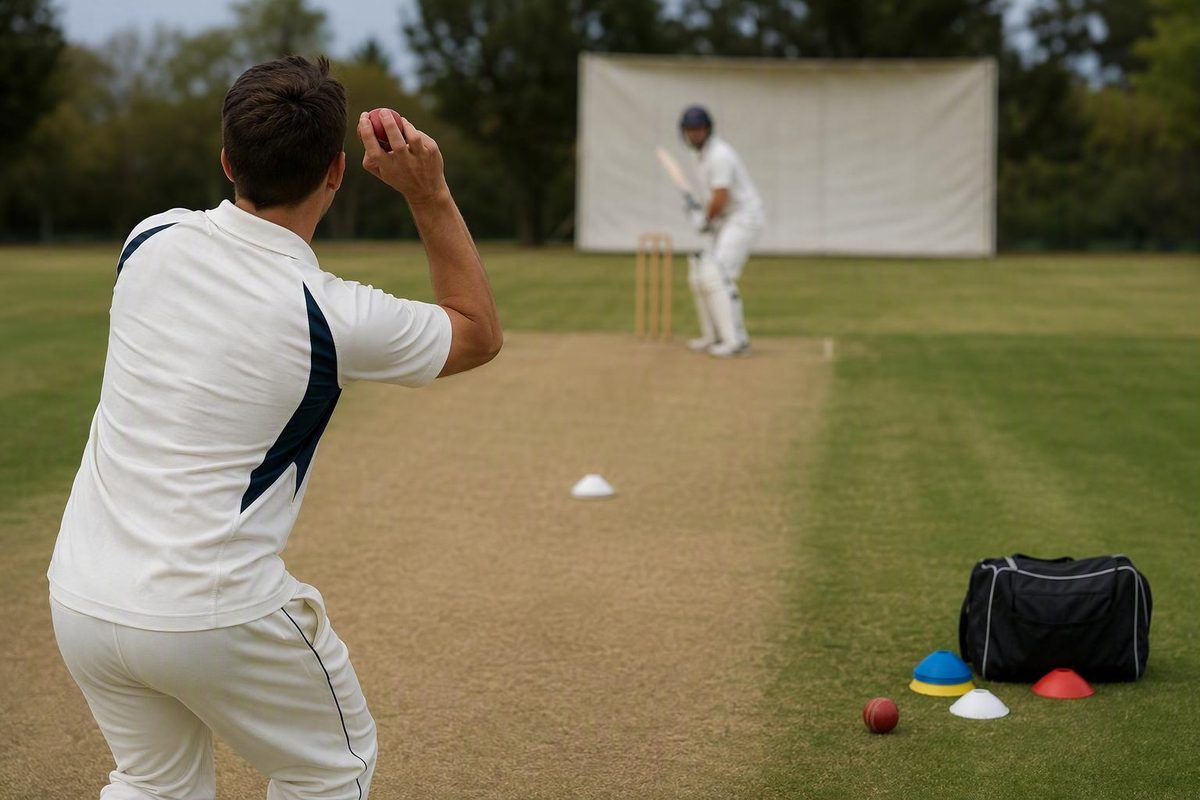
If you want to bowl better, make “better” observable. For a spin bowler, that usually means delivering your stock ball with useful rotation into a repeatable area—not trying a different variation every few balls.
Your stock ball is the delivery you trust most: an off-break for most finger-spinners or a leg-break for most wrist-spinners. Keep its usual grip and action throughout this session. If you are still deciding which family suits you, start with this guide to how spin bowling works.
Queensland Cricket’s beginner-to-club framework makes the same priorities explicit: developing spinners should attempt to maximise spin, use a simple and balanced approach, and deliver from a consistent body position (Queensland Cricket). This session turns those broad priorities into one repeatable drill.
Define today’s version of “better”
Use three measures:
- Intent: Did you try to spin your stock ball normally rather than guide it?
- Length: Did the ball first pitch inside your target?
- Repeatability: Can you reproduce both across several blocks?
Do not use turn alone as your score. The surface may grip, skid or bounce unpredictably. Judge the controllable parts: release intent and pitching location.
Set up one useful target
You need a safe practice area, a set of stumps, 12 or more balls, four flat markers and a notebook or phone.
Create a rectangular landing gate on the line you intend to bowl. Start with a generous target—roughly 1.5 metres long and one metre wide—placed around the length from which your stock ball threatens the stumps or draws a batter forward. Exact placement will change with your pace, trajectory and practice surface.
If you have a batter, remove them for the baseline. You first need to see what your stock ball does without changing your plan in response to a shot.
Before bowling, choose one release cue:
- Finger-spin: “finish the fingers over the ball.”
- Wrist-spin: “let the wrist and fingers complete the release.”
- Either style: “balanced at release.”
These are attention cues, not demands to rebuild your action. Pick the cue that produces your normal stock ball and leave everything else alone.
Bowl a 24-ball baseline
Warm up as you normally would, then bowl four sets of six from your normal approach. Rest briefly between sets so that rushing does not become part of the test.
After every delivery, record one symbol:
- S — landed in the gate with normal spin intent
- G — landed in the gate, but you guided or under-spun it
- X — missed the gate
Add a short directional note to each miss: F for full, S for short, L for left and R for right. A ball can have two notes, such as X-S-R.
Do not fix anything during the first 24 balls. The baseline is a sample, not an exam. Constant mid-block changes make it impossible to tell whether one cue helped.
Read the pattern, then change one thing
Count your S, G and X results. Next, total the miss directions.
Choose the most common problem and one matching adjustment:
- Mostly short or full: keep the same grip and release; mark your starting point and make the approach rhythm more repeatable.
- Mostly left or right: check that your approach and momentum continue towards the intended line rather than falling across it.
- Many G balls: enlarge the gate if needed and restore normal spin intent. Accuracy achieved by steering the ball is not the target of this drill.
- No clear pattern: repeat the baseline before changing technique. Random misses do not yet identify a specific correction.
Keep the adjustment simple enough to say in a few words. “Stay balanced through release” is usable. A list involving the front arm, head, wrist, hip and follow-through is not.
Bowl the comparison block
Repeat four sets of six with the same target, stock ball and scoring method. The only planned difference should be your selected cue or setup adjustment.
Compare the two blocks:
- More S results means the change improved the combination you want.
- More hits but fewer S results means you found the target by sacrificing release intent.
- A tighter miss pattern can still be progress even if the hit total is unchanged.
- A worse or equally scattered pattern means the adjustment has not earned another layer of complexity.
If preserving rotation while improving control is the main difficulty, use the more focused spin-bowling accuracy drills.
Progress only when the stock ball holds up
Keep the same gate until you can score at least 14 S balls out of 24 in two separate sessions. That threshold is a practical checkpoint for this drill, not a universal coaching standard.
Once you reach it, change only one constraint:
- narrow the gate slightly;
- add a standing batter who does not play a shot;
- nominate an off-stump or middle-stump line before each set;
- alternate between two planned lengths while keeping the same stock-ball release; or
- bowl one six-ball over with a simple field and match situation in mind.
Do not add a variation merely because one baseline went well. Queensland Cricket describes its development framework as a tool rather than “a recipe for immediate success,” and advises adapting principles to the player and training environment (Queensland Cricket).
Keep a record that guides the next session
Write down only:
- date and surface;
- gate size and location;
- baseline S score;
- adjustment used;
- comparison S score;
- dominant miss; and
- the one cue to test next time.
New Zealand Cricket’s coaching code calls for planned training appropriate to the player, recognises development as a long-term process and says to maintain appropriate records (New Zealand Cricket). A small, consistent record is more useful to a self-coached bowler than a long technical diary written once.
Your next practice now has a clear starting point: the same stock ball, the same measurement and one change justified by the previous 48 deliveries.