
How Spin Bowling Works—and How to Start Practising It
Learn how rotation produces drift, dip and turn, identify your natural spin family, and practise a stock ball with measurable 12-delivery target blocks.
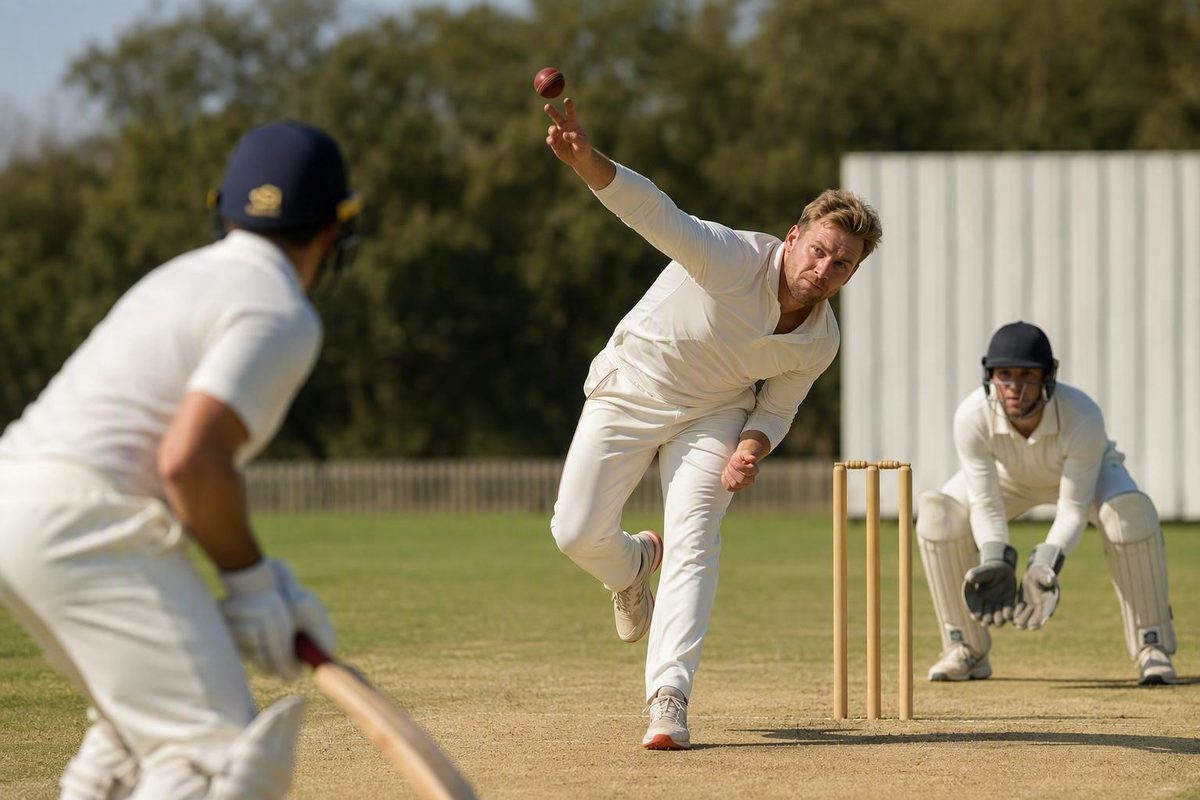
A spin bowler delivers the ball relatively slowly while applying rapid rotation to create deception in flight and deviation or variable bounce after pitching. If you are learning, identify your natural spin family, develop one repeatable stock delivery, and measure its line and length. Add pace changes and variations only after you can group that stock ball reliably.
What a spin bowler does in cricket
Cricket bowling has two broad approaches: pace and spin. Pace bowlers primarily challenge batters with speed, while spin bowlers use rotation, trajectory, changes of pace and post-pitch behaviour to create uncertainty.
Seam, swing and spin describe different movement mechanisms:
- Swing is airborne movement conventionally associated with the ball’s seam orientation and condition.
- Seam movement occurs when the ball lands on or near its seam and deviates from the pitch.
- Spin begins with rotation imparted at release and can produce drift before pitching, followed by deviation or variable bounce after contact.
- Drift is the term used for lateral movement through the air specifically in the context of a spinning delivery.
That does not make seam, swing, drift and spin interchangeable terms.
Spin deliveries are often described as travelling at approximately 70–90 km/h, but this is a descriptive range rather than a rule, minimum standard or training target. Bowling slowly does not automatically make a delivery effective, and operating outside that range does not automatically mean a bowler is not using spin. The defining challenge comes from rotation and deception rather than raw pace. The conventional range and broad categories are summarised in this overview of spin bowling.
Mechanically, spin bowling has two main families:
- Finger spin, in which the fingers make the leading contribution to rotation.
- Wrist spin, in which wrist position and release make the leading contribution.
Combining those families with the bowler’s right or left arm produces four familiar styles: right-arm off-spin, right-arm leg-spin, slow left-arm orthodox and left-arm wrist-spin.
Turn is only one part of the craft. A spinner also needs control of line, length, flight, pace and release. A sharply turning ball in an easy scoring area may be less useful than a modestly turning delivery that lands where intended and arrives on a convincing trajectory.
The four main spin-bowling styles
The direction of turn must be described in relation to both the bowling arm and the batter’s handedness. This table assumes a right-handed batter and describes each style’s normal stock delivery.
| Bowling arm | Spin family | Stock delivery | Expected turn against a right-handed batter |
|---|---|---|---|
| Right arm | Finger spin | Off-break | Off side toward leg side; generally into the batter |
| Right arm | Wrist spin | Leg-break | Leg side toward off side; generally away from the batter |
| Left arm | Finger spin | Left-arm orthodox | Leg side toward off side; generally away from the batter |
| Left arm | Wrist spin | Left-arm wrist-spin stock ball | Off side toward leg side; generally into the batter |
These relative directions reverse against a left-handed batter. Phrases such as “turns left” or “turns into the batter” are therefore incomplete unless the bowler’s arm and batter’s handedness are stated.
Right-arm off-spin is finger spin. Its stock delivery is the off-break, which generally turns from a right-handed batter’s off side toward the leg side.
Right-arm leg-spin is wrist spin. Its stock leg-break generally travels in the opposite direction, from a right-handed batter’s leg side toward the off side.
Slow left-arm orthodox is left-arm finger spin. Against a right-handed batter, its stock ball generally turns away, from leg toward off.
Left-arm wrist-spin uses the left wrist to produce the stock delivery. Against a right-handed batter, that ball generally turns in, from off toward leg.
These terms describe different levels of the same classification system. “Finger spin” and “wrist spin” describe the broad release mechanism; “off-spin,” “leg-spin,” “left-arm orthodox” and “left-arm wrist-spin” add the bowling arm and conventional stock-ball direction.
No style is universally best. A sensible starting choice depends on your bowling arm, physical comfort, natural release, repeatability and access to coaching. Look for the style in which you can create rotation without forcing your hand or rebuilding your action after every delivery.
Flight, drift, dip, turn, bounce and skid
A spinning ball can challenge a batter in two stages: before it pitches and at or after it pitches.
Before pitching
Flight is the trajectory and pace deliberately selected by the bowler. Good flight is not simply bowling the ball higher. It means choosing a path that complicates the batter’s judgement of where and when the ball will arrive.
Drift is sideways movement through the air associated specifically with a spinning delivery. It happens before the bounce and is distinct from turn off the pitch.
Dip is the ball dropping during flight.
At or after pitching
Turn is sideways deviation after the ball contacts the pitch. The amount of turn depends on the release and the playing surface.
Bounce describes how high the ball rises after pitching. Overspin can be associated with additional bounce, although the result still depends on execution and surface conditions.
Skid describes a ball travelling through lower or faster than the batter expects after pitching. Back-spinning or lower-rotation variations may skid or stay lower, but no named release guarantees a particular result.
The sequence can be read in two stages:
- Before the bounce: follow the chosen flight, any sideways drift and the ball’s dip.
- After the bounce: look for turn, additional bounce or skid.
This separation matters because visible turn is not the only useful outcome. A delivery that drifts, dips or bounces differently from the previous ball can force a mistake even if it barely changes direction from the pitch.
Build one stock ball before collecting variations
Your stock ball is the delivery you expect to repeat most reliably. It will usually be an off-break, leg-break, left-arm orthodox delivery or the natural stock ball of a left-arm wrist-spinner.
Build it in this order:
- Find a comfortable grip and release. The ball should feel secure without excessive squeezing or a forced joint position.
- Produce repeatable rotation. Look for a release you can reproduce, not one exceptional delivery with dramatic turn.
- Stabilise the approach and release point. Use a consistent run-up or walk-in, balanced delivery stride and repeatable arm path.
- Control line and length. Choose where the ball should land and measure how often it gets there.
- Change flight and pace. Keep the intended landing area while adjusting trajectory or speed.
- Add one variation. Select a delivery that produces a meaningfully different response from the stock ball.
Exact grip details are style-specific coaching options, not universal biomechanics. Finger spacing and the roles of the thumb and ring finger vary among off-spinners, leg-spinners and individual bowlers. A useful grip is one that helps you rotate and release the ball consistently without forcing an uncomfortable position.
Written grip guides can break the release into manageable parts for self-coached players, but written instructions cannot observe your action from different angles or replace specialist in-person feedback.
If one delivery lands short, another slips out full and a third loses rotation, it becomes hard to tell whether the problem is the grip, release point, approach speed or intention.
When changing pace or introducing a variation, try to preserve the same run-up and visible arm speed. The release may change, but the approach should not announce the delivery.
Judge each practice ball against its intention:
- Did it land on the intended line?
- Did it reach the intended length?
- Was the rotation repeatable?
- Did it move as expected?
- Did the action resemble the stock action?
A wicket is not a useful standalone measure in an empty net. A dragged-down ball can hit the stumps, while an accurately bowled delivery can miss them by design. Watch other bowlers, observe batters and experiment, but compare the intended result with what actually happened.
A measurable spin-bowling practice session
You do not need a speed gun or spin-rate sensor to make practice measurable. You need a fixed target, a written record and enough similar deliveries to reveal a pattern.
Equipment and setup
Use:
- 6–12 cricket balls in similar condition
- Stumps
- Four flat markers
- Chalk or masking tape
- A standard cricket pitch
Mark three length areas:
- Overpitched: too full for the stock length you intend to practise.
- Preferred good length: the area you want to hit repeatedly.
- Short: behind that preferred area.
To calibrate the preferred zone, first decide what response you want from the stock ball against the intended batter: for example, drawing the batter forward without offering an easy full delivery. Use a passive batter, a coach or a few unscored trial balls to identify the landing area that produces that response. Mark its front and back boundaries and leave them unchanged for the scored block.
Choose the intended line in the same way. Use the stumps as a fixed reference and select the channel appropriate to your stock delivery and the batter you are imagining. Place all four targets within the preferred length area around that line. The target does not always have to be on off stump; it needs to reflect the delivery you have chosen to practise.
The published drill on which this setup is based uses 6–12 balls, four markers, three length zones and review blocks of 12 deliveries. It proposes 9 of 12 in the preferred zone as a coaching target, not as a scientifically validated or universally optimal standard (see the target-drill structure).
Block one: establish the stock-ball grouping
Bowl 12 stock deliveries. Record every landing zone, including the poor balls.
After the block, count how many landed in the preferred zone. Then classify the misses:
- Predominantly full
- Predominantly short
- Predominantly leg side
- Predominantly off side
- Scattered without a clear pattern
A consistent miss is useful information. A tight group that is slightly too full may call for a small adjustment. A wide scatter suggests that the release or approach is not yet stable enough for tactical refinements.
Block two: vary pace without moving the target
Bowl another 12 stock deliveries while alternating your normal pace with a deliberate pace change. Retain the same intended landing area, run-up and visible arm speed.
Record whether the quicker or slower attempt changes your length. If every slower ball becomes a full toss, the pace change is not yet controlled. Reduce the size of the change rather than chasing maximum contrast.
Block three: introduce one variation
Progress only when the stock ball groups acceptably for your current level. Use this six-ball sequence:
- Stock ball
- Stock ball
- Stock ball
- Stock ball
- Declared variation
- Stock ball
Declare the variation before beginning the run-up. This prevents you from relabelling an accidental delivery after the event. Compare ball five with the stock balls: did the approach or arm speed change visibly, and did the delivery still land in a playable target area?
Keep a simple practice log
Use one table for the intended and actual landing information:
| Delivery | Intended ball | Intended line and length | Actual landing zone |
|---|---|---|---|
| 1 | Stock off-break | Off-stump line; preferred length | Preferred zone |
| 2 | Stock off-break | Off-stump line; preferred length | Short and leg side |
| 3 | Slower stock ball | Same line and length | Overpitched |
Use a second short table for the delivery outcome:
| Delivery | Observed movement | Action felt repeatable? |
|---|---|---|
| 1 | Small turn | Yes |
| 2 | Skidded | No |
| 3 | Little visible turn | Yes |
These separate fields make patterns easier to compare. Keep the notes brief: you are recording evidence, not writing a technical essay after every ball.
This adds visual distraction and decision pressure, but it does not prove that the drill will transfer automatically to matches.
Common variations and when they change the expected ball
A variation should alter the batter’s expectation while remaining controllable and difficult to identify from the approach. Its name matters less than whether you can land it, disguise it and understand its likely behaviour.
| Variation | Usual bowling family | Expected behaviour | Principal practice risk |
|---|---|---|---|
| Googly | Leg-spin | Turns opposite to the stock leg-break | Visible wrist or action change |
| Top-spinner | Finger or wrist spin | Overspin; associated with dip and extra bounce | Losing line while chasing bounce |
| Arm ball | Off-spin or left-arm orthodox | Travels straighter or with the arm | Becoming an uncontrolled quicker ball |
| Flipper | Usually leg-spin | Backspin; may skid or stay lower | Difficult release and inconsistent length |
| Slider | Usually wrist spin | Often skids or bounces less | Overlapping terminology and uncertain outcome |
| Doosra | Off-spin | Turns opposite to the stock off-break | Forced or unfamiliar release |
| Carrom ball | Finger-spin variation | Finger-flicked; direction depends on grip and release | Obvious grip change or poor control |
For a right-arm leg-spinner facing a right-handed batter, the stock leg-break generally turns away. The googly is intended to turn the other way, into the batter. For a right-arm off-spinner in the same matchup, the arm ball offers a straighter response instead of the expected off-break.
Top-spinners use overspin and are commonly associated with dip and additional bounce. Flippers and sliders are often associated with backspin, skid or lower bounce, but execution and terminology are not fully consistent. Two bowlers may use the same name for different releases.
The doosra is an off-spinner’s opposite-turning variation, but no single grip or action should be treated as universal. The carrom ball uses a finger-flicking release and may behave differently according to the grip and release.
Do not rank these variations by rarity or reputation. A delivery is useful only when you can control it without an obvious change in approach or arm speed. Several rarer variations were excluded from the available elite T20 analysis because too few deliveries were recorded, so that research cannot support a reliable universal ranking.
Conditions, match-ups and legal delivery
Dry or deteriorating pitches and older balls often provide more grip for spin, but appearance alone is not enough. Moisture, surface pace, wear, ball condition and the quality of the release can all affect the response.
Use warm-ups to assess three things:
- Bounce: Is the ball climbing, staying low or behaving inconsistently?
- Pace off the surface: Does it reach the batter quickly or hold in the pitch?
- Grip: Does the stock ball deviate, or does it skid on?
Build the plan around what the ball actually does. Do not assume that a dry-looking pitch must turn sharply.
Matchups can inform that plan, but they are not automatic rules. A peer-reviewed analysis examined 23,084 deliveries from six elite international and franchise T20 competitions. In that dataset, stock-ball matchups that naturally turned away from the batter were associated with better run restriction. Right-arm leg-spin also had higher wicket-taking odds against right-handed batters than the compared right-arm off-spin and left-arm orthodox categories, while googlies and carrom balls were associated with favourable outcomes against right-handers (read the elite T20 matchup study).
These were observational associations in elite T20 cricket, not proof of causation or automatic guidance for Tests, ODIs, junior cricket or club matches. Your control, the batter’s method, the field and the surface may matter more than a broad matchup category.
Legal delivery: wrist movement and elbow extension are different issues
MCC Law 21 states that wrist flexion and rotation are permitted during the delivery swing. Its fair-delivery rule addresses straightening of the elbow during the specified part of the action. Front- and back-foot No-ball requirements are separate rules governing where the bowler’s feet land. The official MCC Law 21 page sets out these distinctions.
For formal assessment in international cricket, the ICC procedure uses a maximum permitted elbow-extension threshold of 15 degrees between the bowling arm reaching horizontal and ball release. A reported action is tested at an ICC Accredited Testing Centre under expert supervision rather than diagnosed from ordinary footage or visual guesswork (see the ICC illegal-action procedure).
The MCC Law describes whether a delivery is fair in respect of the arm; the ICC procedure explains how a reported international action is measured. Because competition regulations and official wording can be revised, check the rules applying to your competition. If your action is questioned, seek qualified in-person coaching or formal assessment rather than trying to diagnose and rebuild it from written instructions.
Your immediate plan is simple: choose the natural stock delivery for your arm and spin family, bowl recorded groups of 12 until line and length become repeatable, then add one controlled pace change or variation without changing the visible action. Measured repetitions matter more than collecting names for deliveries you cannot yet land.