
Build Repeatable Spin-Bowling Footwork Without Rebuilding Your Action
A measurable drill for a consistent approach, delivery stride and follow-through while preserving your stock ball’s spin and control.
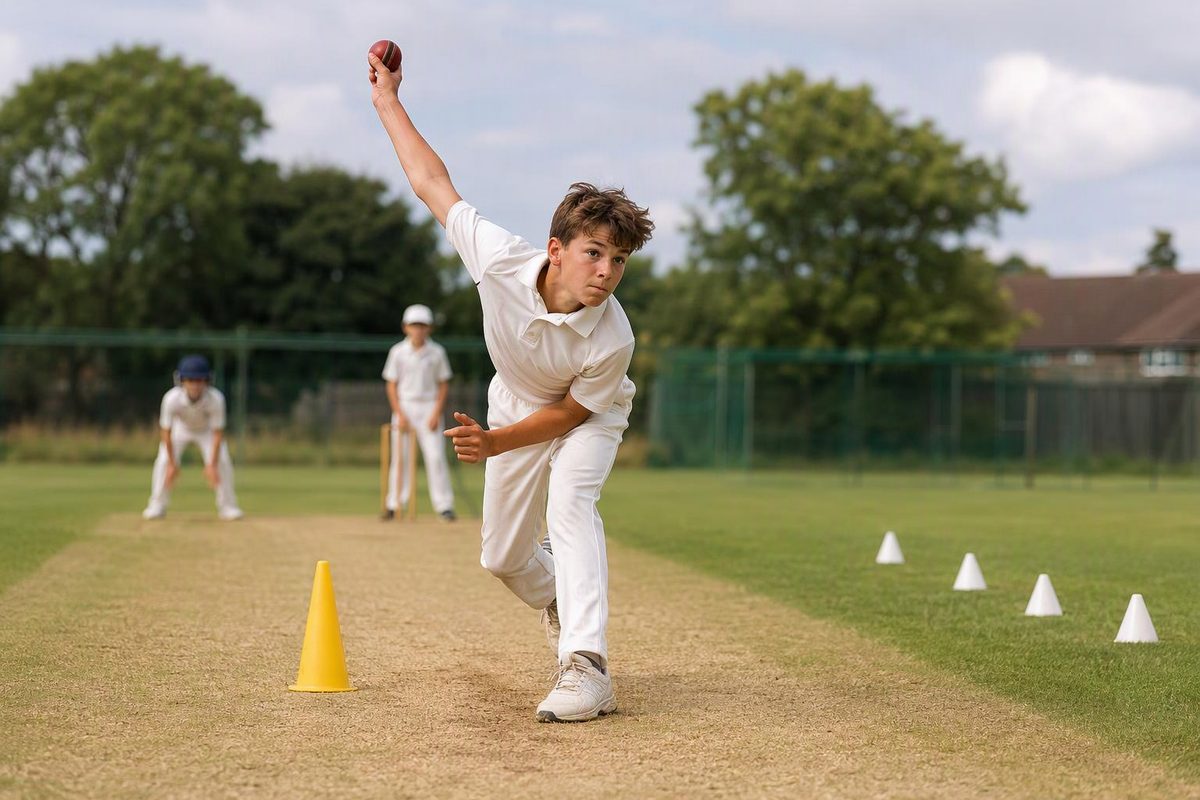
Good spin-bowling footwork does not mean copying another bowler’s exact steps. It means reaching the crease with enough rhythm and balance to release your stock ball without rushing, reaching or falling away.
Use one simple cue:
Arrive balanced, then move through the target.
This applies to finger-spin and wrist-spin. Your grip and release will differ, and your feet may land at different angles, but the practice test is the same: can you repeat the approach while retaining spin and control?
What to observe
Treat the action as four linked parts:
- Approach: gradual movement towards the crease, not a sudden sprint.
- Back-foot landing: the final back-foot contact before the front foot lands.
- Front-foot landing and release: a stable position from which the body can rotate and the bowling hand can complete its work.
- Follow-through: continued movement towards the target rather than an immediate fall to the side.
New Zealand Cricket’s spin-bowling guidance recommends gradual acceleration, a steady head, eyes on the target and movement in the target’s direction. It also advises coaches to preserve the individuality of a spinner’s action rather than imposing one model on every player (NZC Transition to Hard Ball coaching manual).
Do not begin by changing foot angle, stride length and approach speed together. Pick one observable problem.
Set up a footwork lane
You need:
- a ball and stumps
- your normal landing target
- flat markers, tape or chalk
- a phone on a stable support, if available
- a notebook
Place a straight marker line on the ground from your approach towards your bowling target. This is a reference, not a rail that either foot must follow.
Next, bowl six stock balls at comfortable effort. Ask a partner to mark where your back and front feet land. If practising alone, film from behind or use a surface on which landing marks remain visible.
Draw one generous landing zone around the cluster for each foot. Do not create boxes from an imagined “perfect” action. You are measuring whether your existing action repeats.
Keep the front-foot zone comfortably behind the popping crease. Under MCC Law 21.5, the back foot must land within and not touch the relevant return crease. Some part of the front foot, grounded or raised, must land behind the popping crease and on the permitted side of the imaginary line between the middle stumps (MCC Law 21: No ball). Build in a visible margin rather than practising on the line.
The 24-ball drill
Use only your stock ball. A finger-spinner should use the normal off-break or left-arm orthodox release; a wrist-spinner should use the normal leg-break or left-arm wrist-spin release. Do not add a variation to rescue a poor result.
Block 1: six walk-through deliveries
Start two or three walking steps from the crease.
For each delivery:
- look at the intended line and length
- walk in smoothly
- land inside both foot zones
- release with normal spin intent
- finish under enough control to continue forwards
Ignore the outcome of an occasional loose ball. This block asks whether the feet can find the same sequence without full approach speed.
Block 2: six normal approaches
Return to your usual start mark. Keep the cue arrive balanced.
Do not stare at the landing zones during the approach. Look at the bowling target and let a partner, the camera or the marks on the surface show where your feet landed.
If your steps feel crowded, move the start mark back by half a normal walking step. If you repeatedly stretch for the crease, move it forwards by the same amount. Make only one adjustment, then bowl all six deliveries.
Blocks 3 and 4: 12 scored deliveries
Bowl two sets of six from the adjusted mark. Give each delivery one point for each test:
- Feet: both feet land in their zones.
- Control: the ball lands in your chosen target area.
- Stock-ball intent: the release feels committed rather than guided.
- Finish: you complete the action without stumbling or immediately falling sideways.
The maximum is 24 points per six-ball block. Also note any no-ball.
“Committed” is deliberately a feel score. If you can record the seam or visible turn reliably, add that observation in your notes, but do not treat turn alone as a measure of spin: the surface and landing point also affect what the ball does after pitching.
| Scored block | Feet /6 | Target /6 | Intent /6 | Finish /6 | No-balls | Note |
|---|---|---|---|---|---|---|
| 3 | ||||||
| 4 |
How to read the result
Feet repeat, target misses: leave the approach alone for now. Work on line and length while retaining the same rhythm. The measurable stock-ball practice plan provides a suitable next session.
Target is good, feet scatter: you may be making late adjustments that happen to work. Repeat the drill with a slightly slower approach and one fixed start mark.
Front foot repeatedly lands outside its zone: check the previous step before changing the front-foot position. A rushed or wandering back-foot landing can leave the front foot with no comfortable place to go.
You fall sideways after release: widen the landing zones temporarily and use the cue move through the target. Do not force the front foot to point dead straight; test whether your head and momentum continue generally towards the batter.
Spin disappears when the feet improve: the zones are probably too restrictive, or you are placing your feet instead of bowling. Enlarge both zones and restore normal release intent. Footwork is there to support the stock ball, not replace it.
Progression checkpoint
Keep the same start mark when, across two practices, you can:
- land both feet in their zones on at least 9 of 12 scored balls
- hit the target area on at least 9 of 12
- retain normal stock-ball intent on at least 9 of 12
- finish without stumbling on at least 9 of 12
- avoid front- and back-foot no-balls
These are practice thresholds, not universal technical standards. If you miss them, change only one variable at the next session: start mark, approach tempo or landing-zone width.
Stop if the drill causes sharp pain or makes you twist a knee, ankle or back into an uncomfortable position. Footwork should make the action more repeatable, not force your body into a prescribed shape. Persistent pain or a major action change needs assessment from an appropriate clinician and an experienced cricket coach.