
Find The Cause Of Your Spin Bowling No-Balls
Separate overstepping from back-foot and wicket-breaking no-balls, then use a 24-ball check to see whether effort or approach rhythm changes your landing.
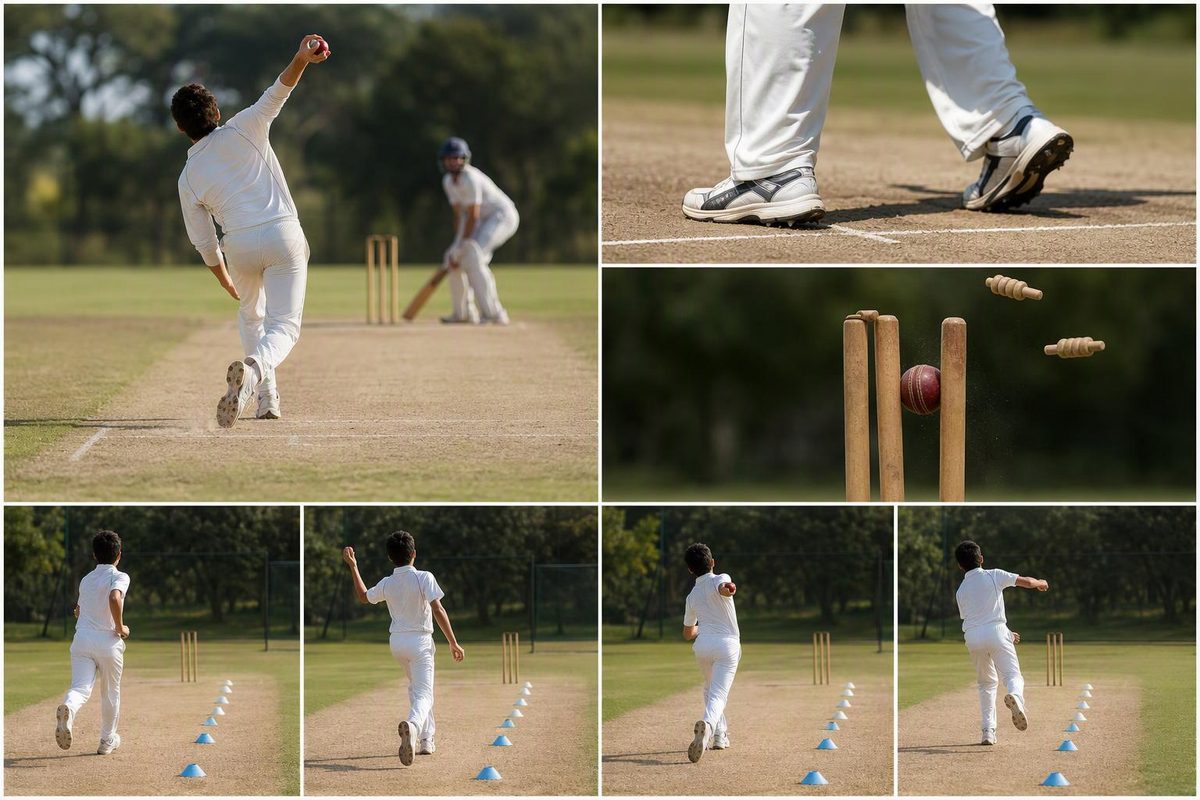
Spinners bowl no-balls because a short run-up does not guarantee a legal delivery stride. Extra effort can move the front-foot landing forward, an inconsistent approach can change the take-off point, and a normally marginal landing leaves little room for error. But not every no-ball is overstepping: a back-foot infringement, breaking the bowler’s-end wicket or an unannounced change of bowling mode needs a different correction.
Identify the offence before moving your run-up mark or changing your action.
Choose the no-ball offence and your landing pattern to find the next check.
Find Your Next No-Ball Check
Check The Landing Frame First
Film 12 stock balls and 12 wicket-seeking balls from the same starting mark. Record clear, marginal, over or unclear landings, plus length-target hits.
Some part of the front foot must be behind the back edge of the popping-crease marking when it lands; that part may be raised. Unclear footage cannot establish legality.
Sources: MCC Laws 7.3 and 21; the accompanying article’s 24-ball coaching check. Results identify a next check, not a proven cause.
Extra Effort Can Move The Landing Forward
Reporting from day four of the Colombo Test against Sri Lanka recorded five no-balls from India’s spinners that day, taking their match tally to 10. Spin-bowling coach Sairaj Bahutule said bowlers sometimes pushed harder while seeking wickets and overstepped despite work on their take-off points. That explains those incidents; it does not prove one cause behind every spinner’s no-balls. Cricbuzz’s report
For your own bowling, separate three patterns:
| Landing Pattern | Possible Cause | What To Compare |
|---|---|---|
| Farther forward at higher effort | Effort changes the stride | Stock balls versus wicket-seeking balls |
| Scattered at either effort | Inconsistent approach | Starting mark and take-off point |
| Consistently marginal | Too little landing margin | Ordinary stock-ball landings |
The take-off point is where you leave the ground before landing in your delivery stride. Starting from the same mark does not establish that you reach the same take-off point each time.
These checks apply to finger-spin and wrist-spin. Diagnose the feet before changing the grip or release. An off-spinner and a leg-spinner do not necessarily need the same technical correction merely because both overstep.
The Landing Frame Determines A Front-Foot No-Ball
For the front foot, some part must be behind the popping crease when it lands, whether that part is grounded or raised. Some part must also land on the correct side of the imaginary line joining the middle stumps, consistent with the bowler’s stated over- or round-the-wicket mode. MCC Law 21.5
The whole shoe does not have to stay behind the popping crease. The crease is the back edge of the painted marking, not its forward edge. MCC Law 7.3
When reviewing your footage, inspect the landing frame rather than judging legality from the foot’s position at release. If the crease or foot is obscured, record the delivery as unclear. Do not turn an uncertain camera angle into a confident diagnosis.
Back-Foot And Wicket-Breaking No-Balls Need Separate Checks
The back foot must land within, and not touch, the relevant return crease—the side boundary of the bowling area. Breaking the bowler’s-end wicket during the period specified in Law 21.6 is a separate no-ball offence.
Cricbuzz reported that Manav Suthar’s no-ball in the Sri Lanka series came from knocking the stumps in his bowling stride, rather than overstepping. Moving the run-up mark backwards is not automatically the right answer to that problem.
Changing arm or switching between over and round the wicket without notifying the umpire can also produce a no-ball under Law 21.1. These offences are covered by MCC Law 21. Use a simple change-of-mode routine when switching.
Television Checks Reveal Errors, Not Their Cause
The ICC’s men’s Test playing conditions, effective October 2026, require the third umpire to review the bowler’s feet landing and advise the on-field umpire of an infringement. That scrutiny makes small errors easier to identify; it does not establish that modern spinners have universally become less disciplined. ICC playing conditions, clause 21.5
Bahutule also suggested free-hits as a deterrent. This was a proposal, not an adopted Test rule. The October 2026 men’s Test conditions provide a one-run no-ball penalty and a delivery that does not count towards the over, with no free-hit provision in clauses 21.14–21.17. Rediff’s report on the proposal
Those are men’s Test conditions. They should not be treated as the playing conditions for every club or junior competition.
A 24-Ball Check Separates Effort From Inconsistency
Use this as a diagnostic session, not a promised cure. Keep the stock delivery and starting mark unchanged between the two blocks so the comparison addresses effort rather than a different variation.
- Set up the view and target. Mark your normal starting point and use a clearly marked popping crease. Place a flat length target, roughly one metre by one metre, at the batter’s end. Film side-on from safely outside the bowling lane, with the crease and landing foot visible.
- Bowl 12 stock balls. Use normal match intent. Cue: “Same approach rhythm; clear landing margin.” Record each front-foot landing as clear, marginal or over, and record whether the ball hit your length target. Inspect the landing frame. Use “unclear” when the footage does not support a judgement.
- Bowl another 12 at wicket-seeking effort. Keep the same stock ball and mark, but simulate a wicket-seeking over at realistic match effort. Record the same landing and target measures.
If only the second block moves forward, investigate the effort change. If both blocks scatter, inspect the approach and take-off consistency. If both are consistently marginal, work on a safer landing margin.
One session is a clue, not proof. Repeat the check before making a major action change. Keep crease control and ball control on the same scorecard: a correction needs to preserve your ability to land the ball on the intended length. For a structured correction session, follow the 36-ball overstepping drill.