
How to Keep a Hot-Weather Spin Session Short, Focused and Safe
Assess the practice area, choose go, modify or stop, then use brief release and stock-ball target blocks with planned shade, drinks and cooling.
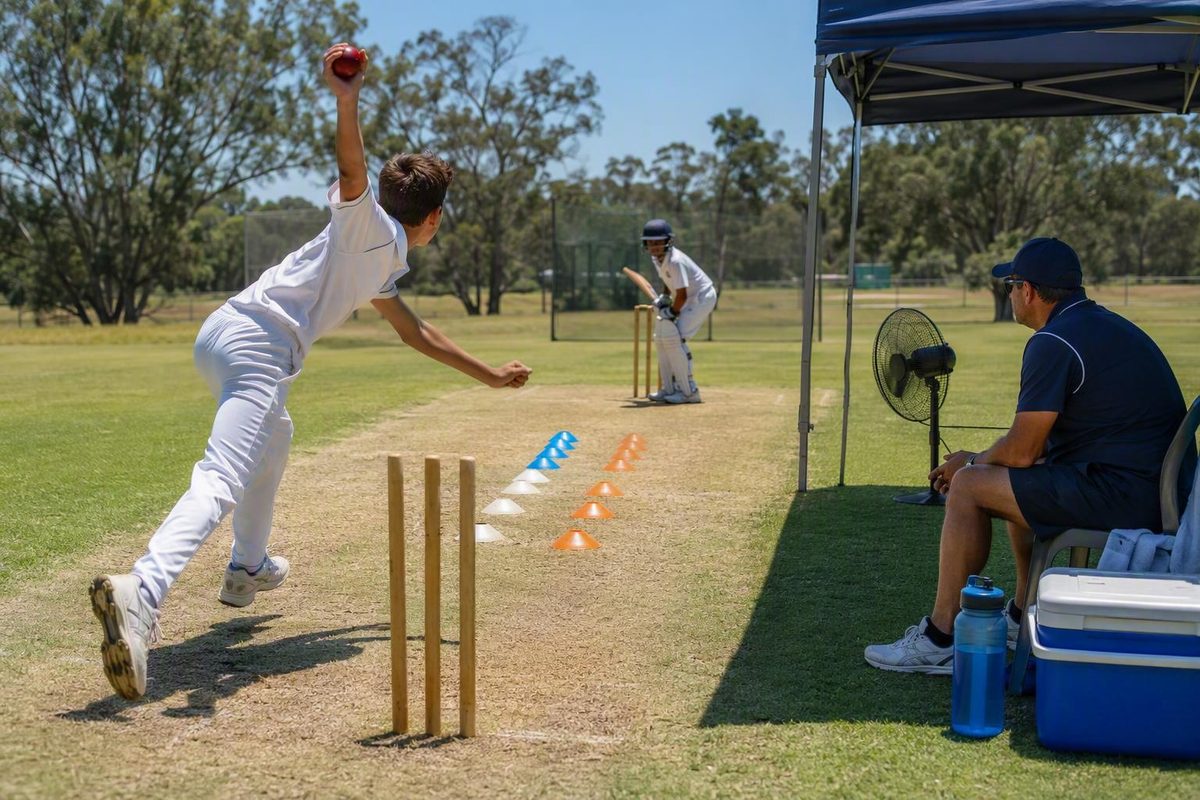
Do not force an unchanged bowling workload into difficult heat. Assess the actual practice area, choose go, modify or stop, and—if training remains appropriate—keep the session to brief blocks of release work and measurable stock-ball accuracy, separated by planned shade, drinks and cooling. Postpone full-pitch work if those controls are not enough.
Start with a go, modify or stop decision
| Go | Modify | Stop or postpone |
|---|---|---|
| Local conditions are manageable, shade and cold water are ready, and every player is well. | Humidity, UV, direct sun, still air, radiant heat or limited shade increases exposure. Shorten the session, reduce intensity and move suitable drills into shade. | Conditions remain severe, safe shade or fluids are unavailable, or a player develops concerning symptoms. |
| Use short working blocks and reassess during every break. | Remove competitive overs, long spells, full-field scenarios and unnecessary variations. | Stop immediately. Do not wait for the bowler to complete an over or delivery target. |
Make this decision at the ground, not from forecast temperature alone. Check the forecast and any applicable local heat alert before leaving, then inspect humidity, UV, direct sunlight, airflow, shade and heat-radiating surfaces at the practice area. Venues differ: one may offer a shaded, breezy net, while another may be exposed and still. The ECB therefore recommends considering local conditions and, in extreme heat, shortening, suspending or postponing recreational-cricket training (ECB Extreme Weather Guidelines for the Recreational Game).
Where feasible, train early in the morning or during the evening. The ECB identifies approximately 11 a.m. to 3 p.m. as the strongest-sun period. Its guidance applies to recreational cricket in England and Wales and covers all participants; it is not a spin-specific rulebook or a substitute for applicable local guidance elsewhere.
There is also no universal temperature at which every cricket session must stop. Humidity, direct sun, shade, stillness and radiant heat can make ground-level exposure materially different from a headline temperature.
The player matters as much as the weather. Consider age, existing health conditions and how the bowler feels that day. A session that was manageable for one player—or for the same player on another day—may need to be modified or cancelled now.
Use a modular hot-weather spin session
A useful hot-weather session does not need to reproduce a full net. Preserve the highest-value work: a clean stock-ball release and a small number of purposeful attempts at a defined line and length.
The timings and repetitions below are adjustable coaching examples, not proof that a particular workload is safe in every condition. Shorten, move or remove each module according to conditions and player response.
| Module | Example task | Adjustable dose | Priority |
|---|---|---|---|
| Shaded release rehearsal | Hand-to-hand spinning, kneeling release or standing start | 2–4 short sets | Keep first |
| Stock-ball target work | Bowl at a cone gate, hoop or marked landing zone | 2–4 sets of 4–6 balls | Main task |
| One secondary skill | Flight, dip, top-spin or arm ball | 1–2 short sets | Optional |
| Shaded review | Record hits, note one cue and reassess conditions | 2–5 minutes | Keep |
Begin with a lower-exposure release drill. Spin the ball from hand to hand, bowl from a kneeling position or use a standing start without a full approach. These are practical ways to isolate the release, not scientifically validated heat interventions. If using a wall, confirm that the surface, rebound area and surrounding space are safe.
Next, define the stock-ball task. Put down a hoop, mark a landing rectangle or create a cone gate on the intended line and length. Count target hits instead of chasing an arbitrary total. For example, bowl six purposeful attempts, record the result and move into shade. The score provides useful feedback without creating pressure to complete a long spell.
Add only one secondary objective if:
- the stock ball remains controlled;
- the player remains well; and
- conditions remain acceptable after reassessment.
That objective might be extra flight, dip, a top-spinner, an arm ball or a deliberate change of trajectory. Do not let one variation expand into a complete variations session. A published drill combines stock off-spin, top-spin, an arm ball and competitive overs in a 45-minute structure, but that is a normal coaching prescription—not evidence that 45 minutes is safe in hot conditions (Vanta Sports three-ball pressure-over drill).
Stumps, cones, hoops and marked lines can measure turn, line and length without prolonged batter-facing work. For example, award one point for landing in the target zone and another for turning past a second marker. Keep the same scoring system if the drill is moved to a shorter or more sheltered setup.
| Replace this outdoor task | With this lower-exposure option |
|---|---|
| Full-pitch stock balls | Standing-start target work |
| Competitive overs | Target scoring without a batter |
| Variation spells | Hand-to-hand or short-release rehearsal |
| Prolonged video work in the sun | Brief shaded review |
When exposure needs to fall, remove competitive overs, extended spells, full-field scenarios and extra variations first. Retain only release work and a small number of stock-ball target attempts—and only while continuing remains appropriate.
Build drinks, shade, cooling and sun protection into the plan
Set up the welfare area before the first delivery. Cold water, shade and any available cooling aids should be beside the practice area, not across the ground or locked in a pavilion. The bowler should be able to end a set and move directly out of the sun.
In difficult conditions, make them longer and more frequent than during an ordinary session. A technical set never takes priority over a needed break.
There is no single fluid quantity or electrolyte prescription suitable for every player and session. Requirements vary with the individual, conditions and workload, so do not copy a fixed formula from an unrelated training plan.
Use broad-spectrum SPF 30 or higher, reapplying it at least every two hours and more often during heavy sweating or exertion. Add a suitable hat, UV-protective sunglasses and light protective clothing. These measures reduce exposure; they do not make it safe to continue after symptoms appear. These recommendations and the warning signs below follow the ECB’s recreational-cricket heat guidance.
Know the symptoms that end practice
Possible heat exhaustion — stop activity
Warning signs include tiredness, dizziness, excessive sweating, headache, nausea or vomiting, cramps, marked thirst, weakness, a high temperature, and fast breathing or heartbeat.
Stop bowling immediately and move out of the heat. Do not finish the over, complete the target set or ask for “one last good ball.”
Possible heatstroke — medical emergency
Warning signs include a very high temperature, very hot skin without sweating, confusion, restlessness, seizure or loss of consciousness.
Seek immediate medical help for suspected heatstroke. Focus on prompt recognition and escalation rather than trying to manage a medical emergency through a practice plan (ECB heat-illness signs, sun protection and escalation guidance).
Accuracy deterioration by itself does not diagnose heat illness. However, if declining control appears alongside unusual tiredness, dizziness, nausea, cramps, weakness or another concerning symptom, safety takes priority over technical analysis.
Make extra adjustments for juniors and accumulated workload
The supervising adult should monitor the player and retain authority to shorten or end the session even when the junior wants to continue.
Track deliveries and perceived effort. A supposedly short session can quietly expand through repeated resets, extra attempts after missed targets and unplanned competitive overs. Record every ball bowled—not only those counted within the main drill—and use a simple effort rating such as easy, moderate or demanding.
Look beyond the current session. Avoid sudden increases in bowling workload and allow recovery between demanding bowling days. This is broad planning guidance, not a validated delivery limit for spin bowlers.
Do not import pace-bowling ball counts into a spinner’s plan. Published schedules with weekly numerical targets may have been designed specifically for junior and club fast bowlers, so those figures should not be presented as established limits for spinners (fast-bowler workload plan and scope).
A practical record can include:
- total deliveries;
- number of full-approach deliveries;
- target hits;
- perceived effort;
- time spent in direct sun;
- drink and cooling breaks;
- symptoms during or after practice;
- the previous and next demanding bowling day.
A general practice plan cannot provide personal medical clearance.
Do not diagnose every loose ball as a heat effect
A June 30, 2026 Reddit post title reported that a spinner took more deliveries than usual to settle line and length in hot weather. Treat this as one anecdote, not proof of cause. The underlying video was not assessed, no heat illness was established, and the title cannot show that heat caused the technical difficulty.
There is no need to diagnose the cause at the ground.
If control deteriorates:
- Pause the current set and move into shade.
- Take the planned drink and cooling break.
- Reassess the player and the actual conditions.
- End practice if symptoms appear or exposure cannot be managed.
- If continuing remains appropriate, return only to release rehearsal or a small stock-ball target set.
Across several sessions, record local conditions, direct-sun exposure, perceived effort, symptoms and target-hit results. Patterns may help with personal planning—for example, choosing an earlier start or shortening full-pitch blocks—but they are not scientific proof that heat caused a technical change.
Before the next hot-weather spin session:
- Inspect the actual venue, including sun, shade, humidity, airflow and radiant heat.
- Choose go, modify or stop before starting and reconsider during every break.
- Keep the stock ball as the main technical goal.
- Place cold water and shade beside the drill.
- Use planned drink and cooling breaks.
- Stop at the first concerning symptom.
Postponing full-pitch work when the heat cannot be managed is not a failed practice. It is a sound training decision that protects the player and preserves better-quality bowling for another day.