
Where Mid-On Stands and How Spinners Should Use It
See where mid-on stands, how it changes for each batter, when a spinner should adjust it, and a 12-ball drill for sharper stops and returns.
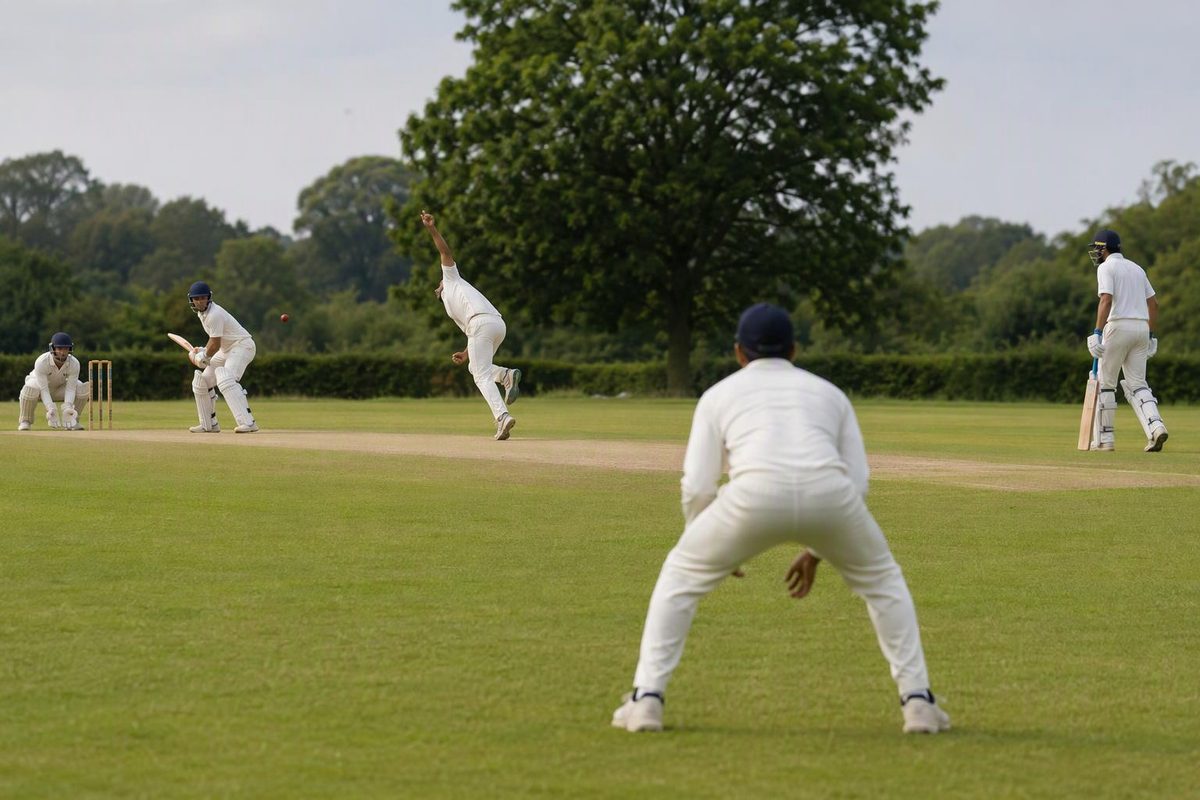
Mid-on is an on-side—or leg-side—fielding position in front of the striker, fairly straight and normally well inside the boundary. Picture a line from the batter towards the bowler, then move towards the batter’s leg side. Mid-on covers the on-drive, challenges the straight single and may collect a mistimed shot.
Choose the batter, your priority and the scoring pattern to get a starting position.
Choose a Mid-On Starting Position
Change the selections as the batter’s scoring pattern becomes clear.
Right-handed striker: Stand on the striker’s leg side—the left from the batter’s view—in front of the striker.
Use conventional mid-on and come slightly closer only if the fielder still has time to react to a firm drive.
No repeated gap is evident, so hold the starting position and reassess after a clear pattern develops.
Source: position descriptions from Sportplan; fielding restrictions from MCC Law 28.
For a right-handed batter looking towards the bowler, mid-on is to the batter’s left. It moves to the other side of the pitch for a left-hander because “on side” and “leg side” are defined in relation to the striker. A field-position guide from Sportplan likewise places mid-on on the leg side, opposite mid-off.
The suggested position is a coaching starting point, not a fixed coordinate. The captain should adjust it for the batter, bowler, surface and match situation.
Mid-On, Silly Mid-On and Long-On
These positions occupy roughly the same leg-side angle but serve different purposes:
- Silly mid-on: Extremely close to the batter, primarily looking for a catch.
- Short mid-on: Closer than conventional mid-on, making a pushed single difficult and sometimes offering a catching chance.
- Mid-on: An inner fielder who stops straight drives and singles.
- Long-on: A deep fielder, usually near the boundary, protecting against lofted straight or leg-side shots.
There is no fixed distance in metres for conventional mid-on. Gray-Nicolls groups mid-on among the inner-ring positions and describes it as the leg-side mirror of mid-off.
For the close-catching position, see silly mid-on in cricket.
Mid-On Stops the Straight Single
A batter can push a full ball towards the bowler’s end and try to rotate the strike. Mid-on’s first job is to reach that ball cleanly and make the run uncertain.
Start balanced. A small walk-in can help the fielder arrive on the balls of the feet as the stroke is played, but it should finish in a position from which they can move in either direction. Charging forward too early makes a firm on-drive harder to stop.
Bringing mid-on slightly closer can challenge the batter’s attempt to push a flighted delivery down the ground for one. The batter must then defend, find a narrower gap or hit over the fielder.
That does not make every short mid-on a realistic catcher. If the intended chance is a hard hit close to the bat, use a fielder with suitable protective equipment and follow the competition’s safety rules, especially in junior cricket.
Mid-On Protects the On-Drive
Conventional mid-on covers the reasonably straight on-drive. If the batter repeatedly scores between mid-on and midwicket, move the fielder a few paces wider. If the shot keeps passing between the bowler and mid-on, move straighter.
Make one adjustment at a time. A fielder moved wider cannot also protect the same straight channel, so the bowler and captain must agree which shot they are prepared to concede.
The bowler’s label does not decide the position by itself. Whether you bowl finger-spin or wrist-spin, place mid-on for the shot your line, length and field plan are intended to invite or prevent.
Adjust Mid-On to the Scoring Pattern
Start straight enough to cover the on-drive and close enough to challenge a comfortably struck single. Then respond to what happens:
- Balls repeatedly pass one side: Shift the angle by two or three paces.
- Pushed singles are too easy: Come in slightly, provided the fielder still has time to react to a firm drive.
- Firm drives keep beating the fielder: Move back or change the angle.
- The batter advances and hits over mid-on: Use long-on if boundary protection is the priority. Do not leave the fielder stranded between an inner-ring and boundary job.
- A left- and right-handed pair rotates strike: Move mid-on to the new striker’s leg side and confirm the angle before the next ball.
Each change gives up some protection elsewhere. Moving wider covers the gap towards midwicket but opens more space beside the bowler. Moving closer attacks the single but reduces reaction time. Moving to long-on protects the boundary while conceding an easier single.
A 12-Ball Drill Measures Mid-On Fielding
This drill practises the approach, pickup and controlled return needed to challenge a single. It does not attempt to reproduce a batter’s exact running speed.
Set Up the Gate and Target
- Mark a six-metre-wide gate in the mid-on area with two cones.
- Set a stop line two metres behind the fielder’s starting position.
- Mark a two-metre target square beside the bowler’s-end stumps. A partner can receive throws from beside the square, away from the stumps.
- Put a feeder near the batting crease. Begin with rolled balls; progress to controlled shots only when the fielder is ready.
Use a realistic mid-on depth for the player’s age and throwing range. Keep every other participant out of the throwing lane.
Feed 12 Balls in Mixed Directions
Feed four balls near the middle of the gate, four to the fielder’s left and four to the right, in a mixed order. Do not reveal the direction in advance.
For each ball, the fielder should:
- Complete a small walk-in and become balanced as the ball is released.
- Move towards the ball under control.
- Stay low through the pickup.
- Gather with two hands when time permits.
- Return the ball towards the target square and move into a backing-up position.
Score Stops and Returns Separately
Award up to two points per ball:
- 1 stop point: Field the ball cleanly before it crosses the stop line.
- 1 return point: After a clean pickup, the throw or controlled underarm return first lands in or passes through the target square at a catchable height.
Record the two scores separately. For example, 11 stops and six returns indicates that the starting position is workable but the pickup-to-throw transition needs attention. Seven stops and 11 returns suggests the player should test a different starting depth or improve the first movement.
After two rounds scoring at least 18 out of 24, either narrow the gate by one metre or increase the feed speed slightly. Change only one condition so you can tell what affected the score.
Law 28 Does Not Define a Fixed Mid-On Position
“Mid-on” is a conventional fielding name, not a marked location in the Laws. Under MCC Law 28 as published on 25 September 2026, no more than two fielders other than the wicketkeeper may be behind the popping crease on the on side at the instant of delivery. Conventional mid-on is in front of that crease, so it does not normally count towards that limit.
The same Law says a fielder must not encroach on the pitch before the ball reaches, touches or passes the striker. Before the ball reaches the striker, it permits minor adjustments and limited movement towards the striker by a fielder who is not close, provided that movement does not significantly alter the position. The umpire judges unfair movement (MCC Law 28). Competition playing conditions can add fielding-circle and junior-safety restrictions.
To fit mid-on into a complete plan, use this spinner’s guide to cricketing field positions.