
Learn Every Field Position and Build a Spin Field
Learn cricketing field positions by side, angle, depth and purpose, then choose a spinner’s field and test it with a practical 24-ball mapping drill.
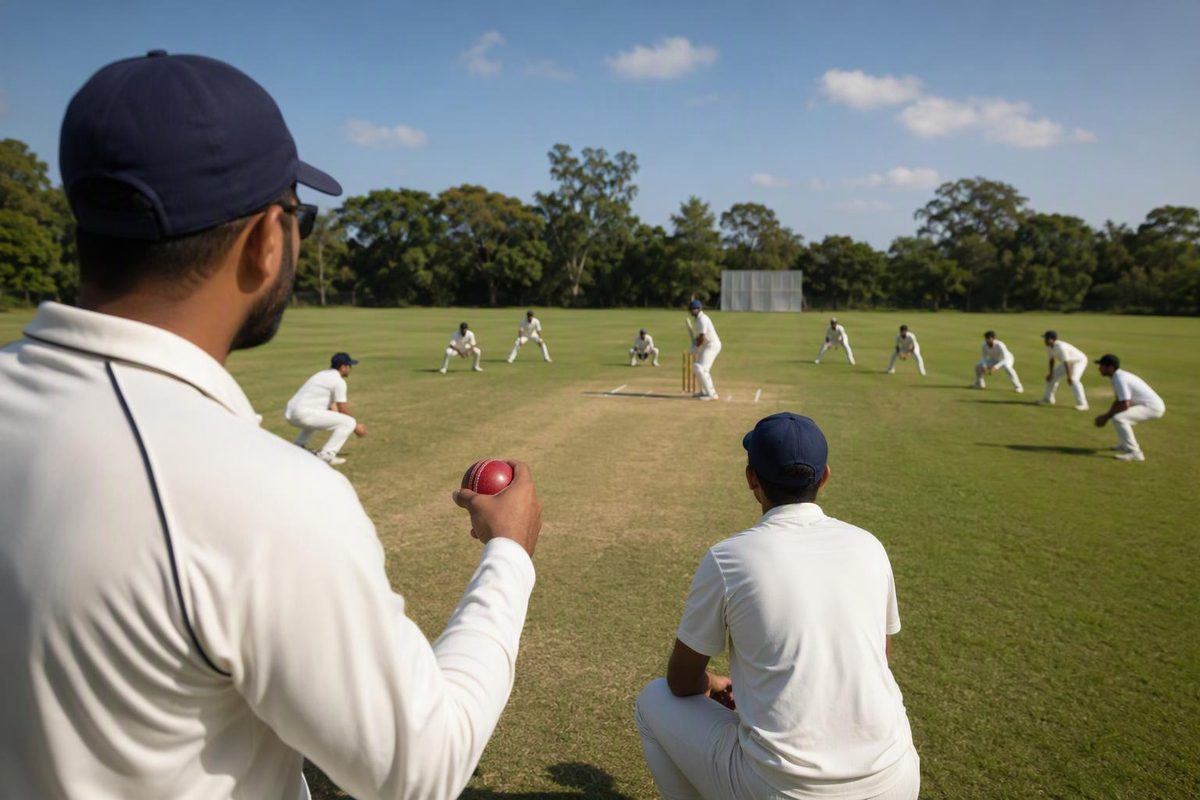
Cricketing field positions are easiest to learn by side, angle, depth and purpose, not as isolated dots on a diagram. Start from the striker, identify the off or leg side, judge whether the position is straight, square or behind square, then decide whether its job is catching, saving one or protecting the boundary. The descriptions below use a right-handed batter; the off-side and leg-side areas switch for a left-hander.
Choose the chance your stock ball is intended to create; the tool suggests the first positions to consider.
Spin Field Position Picker
These are starting positions, not a complete nine-fielder setup.
Outside Edge
Start with slip as the catcher.
Use point or backward point to control the easier square single, then adjust from the edges and scoring shots you actually produce.
Show All Six Position Mappings
- Outside edge: slip, supported by point or backward point.
- Inside edge or bat-pad: short leg, only when permitted and safely equipped.
- Mishit over the bowler: mid-off and mid-on; consider long-off or long-on after repeated lofted shots.
- Sweep: square leg, backward square leg or fine leg.
- Drive against the turn: cover or extra cover.
- Leg-side clip: midwicket, adjusted finer, squarer or deeper from observed shots.
Source: position-to-chance mappings in this guide; close-catching safety caveat follows the ECB Recreational Cricket Safety Guidelines, December 2025.
Start With Off Side and Leg Side
In a normal right-handed stance, the off side is the side away from the batter’s legs. The leg side, also called the on side, is the side behind the legs.
A standard match has 11 players per side. With one player bowling and one keeping wicket, the captain has nine other fielders to place. MCC Law 1 also allows matches to be agreed with a different number of players, but no more than 11 may field at once (MCC, Law 1).
Most position names describe four features:
- Side: Off or leg.
- Angle: Straight, in front of square, square or behind square.
- Depth: Close to the bat, saving one or near the boundary.
- Purpose: Catching, stopping a single or protecting a scoring area.
“Square” means roughly level with the striker’s crease. “Fine” moves towards the line behind the striker, while “straighter” moves towards the line from the batter to the bowler. Position names describe areas rather than fixed marks on the grass.
Positions Behind the Wicket
- Wicketkeeper: Directly behind the striker’s stumps. A keeper often stands up to the stumps for spin, depending on skill, bounce and the bowler’s pace.
- Slip: Behind the batter on the off side, beside the keeper, looking for an outside edge.
- Leg slip: Behind the batter on the leg side, looking for a fine edge, glove or deflection.
- Gully: On the off side and squarer than slip. It is more common against pace but can suit a spinner producing firm, square edges.
- Third: A deeper off-side position behind square, traditionally called third man. It can also be brought up to stop a guided single.
- Fine leg: A leg-side position behind square, placed close enough to save one or deep enough to protect the boundary.
Positions Square of the Wicket
- Point: Square on the off side, covering cuts, square drives and pushed singles.
- Backward point: Slightly behind square on the off side.
- Square leg: Square on the leg side, covering clips, sweeps and pulls.
- Backward square leg: Slightly behind square and often moved to match the batter’s sweep.
Positions in Front of Square
- Cover: In front of point on the off side, protecting the drive.
- Extra cover: Between cover and mid-off, at a straighter angle than cover.
- Mid-off: Straight and in front of the batter on the off side.
- Mid-on: The leg-side counterpart to mid-off.
- Midwicket: Between mid-on and square leg, covering clips and cross-batted shots.
Close Catchers Need a Repeatable Chance
- Silly point: Very close on the off side and in front of square, looking for a checked drive, glove or bat-pad chance.
- Short leg: Very close on the leg side, generally square or just in front, looking for an inside edge or a ball that touches the bat or glove before looping up.
- Silly mid-off and silly mid-on: Close, straighter catchers on either side of the pitch. Read the separate guide to silly mid-on before using that position.
“Silly” means exceptionally close, not a precise distance. Close catching with a hard ball requires suitable skill, supervision and protective equipment.
In England and Wales, the ECB recommends that an adult fielder closer than 8 yards (7.3 metres) to the striker wear a helmet with a faceguard or grille. Mandatory requirements for junior cricketers are covered by separate regulations (ECB Recreational Cricket Safety Guidelines, December 2025). Follow the safety rules for your age group and competition.
Deep and Long Positions Protect or Invite Lofted Shots
Add deep when a position moves towards the boundary: deep point, deep cover, deep square leg or deep midwicket.
The straighter boundary positions usually use long:
- Long-off: Deep and straight on the off side.
- Long-on: Deep and straight on the leg side.
A deep position is not automatically defensive. Long-on may be placed specifically to catch a lofted shot. Judge the position by the shot it is intended to receive rather than relying only on an attacking or defensive label.
Translate a Captain’s Instruction Into Movement
Treat each word as an adjustment from the fielder’s current position:
- Finer: Move closer to the line behind the striker.
- Squarer: Move towards a line across the pitch through the striker.
- Straighter: Move towards the batter-to-bowler line.
- Wider: Move farther around the arc from a straight position.
- Shorter: Move towards the batter.
- Deeper: Move towards the boundary.
If an instruction such as “five metres finer” remains unclear, ask the captain to point. Accurate placement matters more than pretending to understand.
Build a Spin Field From the Intended Chance
Do not begin by copying nine dots from a professional match. Begin with the stock delivery you can repeat and the mistake that delivery is meant to produce.
Mark Where the Stock Ball Should Pitch
Use a cone or flat marker for your normal line and length. Finger-spin and wrist-spin stock balls may require different fields, and the intended line may change with the batter’s handedness.
If you do not yet have a repeatable stock ball, start with the target drill in How to Bowl Spin in Cricket.
Choose One Primary Chance
Match the field to the mistake you are trying to produce:
- Outside edge: Consider slip, with point or backward point controlling the easier scoring option.
- Inside edge or bat-pad: Consider short leg, provided the fielder is equipped and allowed to stand there safely.
- Mishit over the bowler: Place mid-off and mid-on at useful catching or run-saving depths. Move one to long-off or long-on when repeated lofted shots justify it.
- Sweep: Cover square leg, backward square leg or fine leg according to where the shot is going.
- Drive against the turn: Place cover or extra cover in the expected path.
- Leg-side clip: Start with midwicket, then adjust it finer, squarer or deeper from observed shots.
A conventional leg-break turns towards the off side of a right-handed batter; a conventional off-break turns towards the leg side. That influences likely edges and scoring arcs, but it does not create a universal field. Line, length, pace, bounce, pitch and batter all matter.
Decide Which Single You Will Concede
Nine movable fielders cannot cover every shot. Decide which low-risk single you can accept, then keep bowling the delivery that makes the batter’s stronger boundary option difficult.
Some competitions restrict how many fielders may stand outside a marked circle during particular overs. The details vary by format and competition, so check the playing conditions for your match. The ICC publishes separate conditions for its competitions (ICC playing conditions).
Test the Field With a 24-Ball Mapping Drill
This drill compares your proposed field with the shots your bowling actually produces.
Set Up Eight Scoring Sectors
Use one batter, a wicketkeeper and cones. Mark the landing target for your stock ball, then draw an oval divided into off side and leg side.
Split the oval into eight sectors: straight off, cover, point, behind off, straight leg, midwicket, square leg and behind leg. Bowl only your stock delivery during the drill.
Record Every Legal Delivery
Bowl 24 legal deliveries in four blocks of six. After each ball, record:
Tif the ball landed in the target;- the sector through which the shot travelled;
Afor an aerial chance,Gfor a ground shot orMfor a miss;- the outcome: dot, one, two, three or boundary.
A completed entry might read T / square leg / G / 1. For a miss, record the side on which the keeper collected it if that information is useful.
Change One Position at the Checkpoint
After 24 balls, count the entries in each sector. As a practical review rule, do not move a fielder for one unusual stroke. Consider an adjustment when the same controlled shot appears at least three times, or when two genuine aerial chances reach the same unguarded area.
Change one position only, then bowl another 24 balls. Possible adjustments include:
- moving square leg ten metres deeper;
- making cover squarer when shots repeatedly pass towards point;
- bringing mid-on straighter when the batter pushes past the bowler;
- adding a close catcher only when the chance is repeatable and the fielder can take the position safely.
Keep the landing target unchanged. If you alter the delivery and field together, you cannot tell which change affected the result.
Law 28 Limits Where Fielders Can Stand and Move
Under MCC Law 28, at the instant of delivery no more than two fielders other than the wicketkeeper may be behind the popping crease on the on side; an infringement is a no-ball.
The Law also prevents a fielder other than the bowler from encroaching on the pitch while the ball is in play and before it touches the striker’s bat or person, or passes the bat. Movement by a fielder other than the keeper after the ball comes into play and before it reaches the striker is restricted, although the Law permits specified minor adjustments and movements in response to the intended stroke (MCC, Law 28). Check your competition’s current playing conditions as well as the Laws.
Name each position by side, angle, depth and purpose, then test whether your stock delivery sends the ball there. The name locates the fielder; the repeatable delivery gives the position a job.