
Build a Repeatable Left-Arm Orthodox Stock Ball
Learn the left-arm orthodox grip and release, then use a 48-ball drill to measure stock-ball accuracy, clean rotation and session-to-session control.
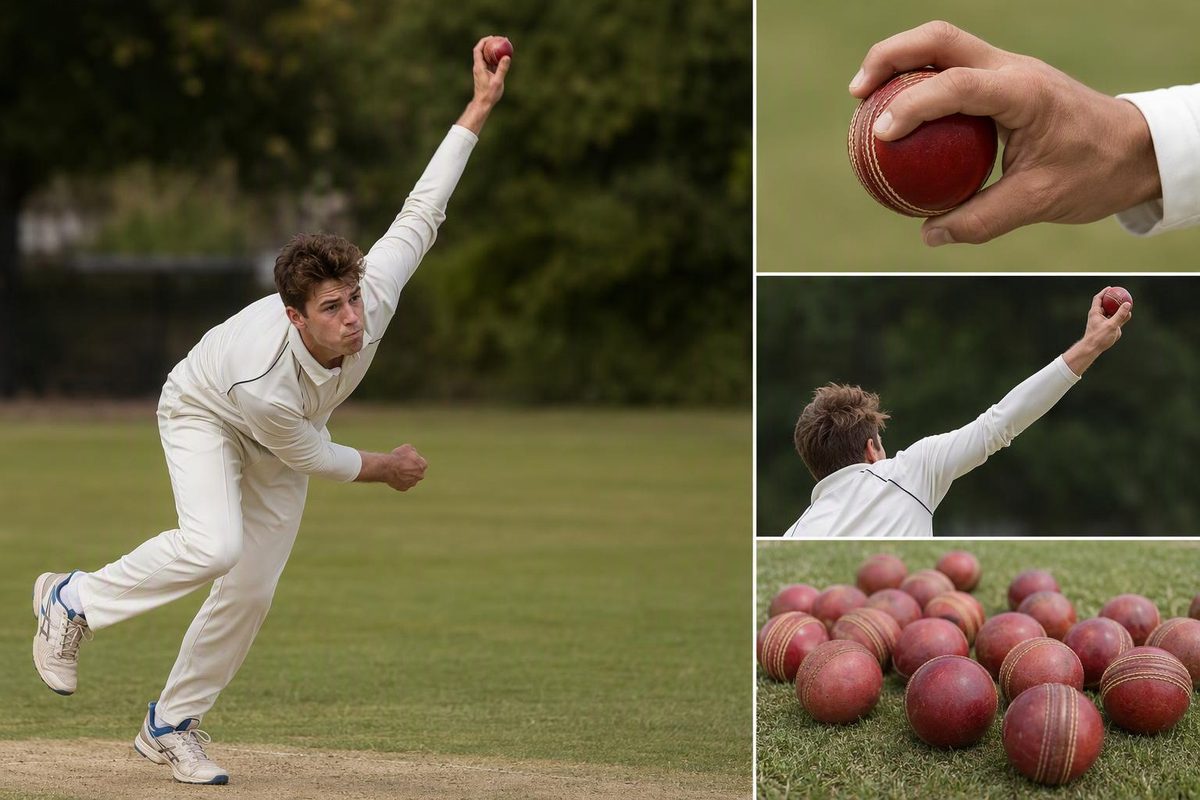
Left-arm orthodox spin is left-arm finger spin. Its stock ball turns from leg to off—away from a right-handed batter and into a left-handed batter. It is the left-handed counterpart of right-arm off-spin, not left-arm wrist-spin. A study of 23,084 deliveries in elite T20 cricket uses the same distinctions for left-arm orthodox and left-arm wrist-spin stock balls (Journal of Sports Analytics study).
Build a repeatable stock ball before adding an arm ball, topspinner or deliberate change of pace.
Enter your landing and spin marks after the 48-ball drill; the scorecard compares them with the practice targets.
48-Ball Scorecard
Each total must be a whole number from 0 to 48.
Session Readout
Repeat the drill in a second session before shrinking the target.
Source: the 48-ball drill and adjustable practice targets in this guide.
Set a Comfortable Finger-Spin Grip
- Place the middle joints of your index and middle fingers across the seam, leaving a clear gap between the fingers.
- Let the ball rest lightly against the ring finger.
- Keep the thumb relaxed. It may touch the ball, but it should not squeeze upwards.
- Hold the ball firmly enough to control it, but not so tightly that it sticks in the hand.
The BBC’s left-arm spin guide describes the same spread-finger grip, with the ball resting against the third finger and little involvement from the thumb. It also identifies the index finger and wrist as the main sources of rotation (BBC Sport Academy).
Do not force the widest grip you can manage. If the ball slips, your fingers feel strained or you have to steer it out of the hand, narrow the gap slightly.
Check the Grip From Short Range
From five to seven metres, make 12 gentle releases to a partner, rebound net or safe backstop. Use no approach and concentrate on making the seam rotate cleanly.
Add one walking step for another 12 releases. If the seam becomes much less stable, return to the stationary version. Check the release before changing the grip.
Use One Stock-Ball Release Cue
Start with one cue:
Index finger over the ball; bowling hand continues towards the target.
Use the wrist and index finger together as the ball leaves the hand. Keep the bowling arm moving rather than stopping it in an attempt to manufacture extra sideways spin.
Judge the release by the ball’s rotation, not only by how far it turns after pitching. The surface may offer little turn, while an accidental deviation can flatter a poor release. Look for visible, repeatable rotation with a reasonably stable seam.
If that is difficult to assess at full length, ask a partner to watch from behind the stumps. You can also record several deliveries from safely behind the bowler, then compare them at slow speed. Keep the camera and tripod clear of the approach and follow-through.
For a fuller progression that balances rotation with control, use the spin-bowling accuracy drill.
Keep the Action and Starting Point Repeatable
Use a short approach that lets you arrive balanced. The number of steps matters less than repeating the same starting point and rhythm.
During the delivery:
- focus on the landing area;
- use the non-bowling arm to help you reach up and align;
- release from a comfortable height without leaning sharply sideways;
- let your chest and bowling arm continue through the crease;
- finish balanced enough to watch the ball and field it.
Choose either over or around the wicket for the whole practice block. Many left-arm orthodox bowlers operate around the wicket to a right-hander, bringing the ball towards the batter before trying to turn it away. The BBC guide describes this common angle.
Do not switch sides every few balls. That makes it harder to tell whether your release is becoming more consistent.
Bowl the 48-Ball Stock-Ball Drill
Mark a Practical Landing Area
You need:
- one stump or a full set of stumps;
- four flat markers;
- a notebook or phone note;
- ideally, a partner or safe backstop.
Mark a generous landing rectangle on a length that leaves the batter uncertain about coming fully forward or playing back. A rectangle about 90 centimetres long and 60 centimetres wide is a practical starting point, not a universal good-length measurement. Move it nearer to or farther from the stumps to suit the pace and bounce of the surface.
For a right-handed batter, start with the rectangle around an off-stump to middle-and-off line. The stock-ball intention is to pitch there and turn away. Against a left-hander, the same release turns in, so change the intended line rather than trying to reverse the spin.
Score Landing and Rotation Separately
Bowl eight sets of six with your normal approach. Rest briefly after each set.
Give every delivery two separate scores:
- L — landed in the rectangle;
- S — showed the clean, purposeful rotation established in the short-release drill.
A ball can earn both marks, one or neither. Do not award an S merely because the pitch made the ball turn. If you cannot judge rotation while bowling, have a partner score S or review a short recording after each set.
Use the first four sets as your baseline. Before balls 25–48, make one adjustment:
- Mostly short: maintain your forward movement and complete the arm path.
- Frequently leg side: check your balance and alignment with the target.
- Accurate but wobbling: return your attention to the index-finger cue.
- Clean rotation but scattered length: reduce effort slightly without changing the release.
Do not add an arm ball during this drill. You are testing whether one stock release survives the full action.
Compare the Two 24-Ball Blocks
After 48 balls, total L and S separately:
| Block | Landing Marks | Spin Marks | Note |
|---|---|---|---|
| Balls 1–24 | 13 | 17 | Short when approach rushed |
| Balls 25–48 | 16 | 18 | Slower first two steps |
This example finishes with 29 landing marks and 35 spin marks. More importantly, both measures improve after one controlled adjustment.
At the next session, try to improve one total without letting the other collapse. As an initial progression benchmark, aim to land at least half the balls in the rectangle and show your intended rotation on about three-quarters of them in two separate sessions. These are adjustable practice targets, not selection standards.
Once you reach them, reduce the rectangle slightly or add a batter-shaped visual marker. If accuracy improves only when you stop spinning the ball, widen the target again. A useful left-arm orthodox stock ball needs repeatable rotation as well as a line and length that challenges the batter.