
How to Bowl a Carrom Ball: Start With the Finger Flick
Learn the carrom ball grip and middle-finger release, then use a staged 36-ball drill to record clean spin, landing control and turn.
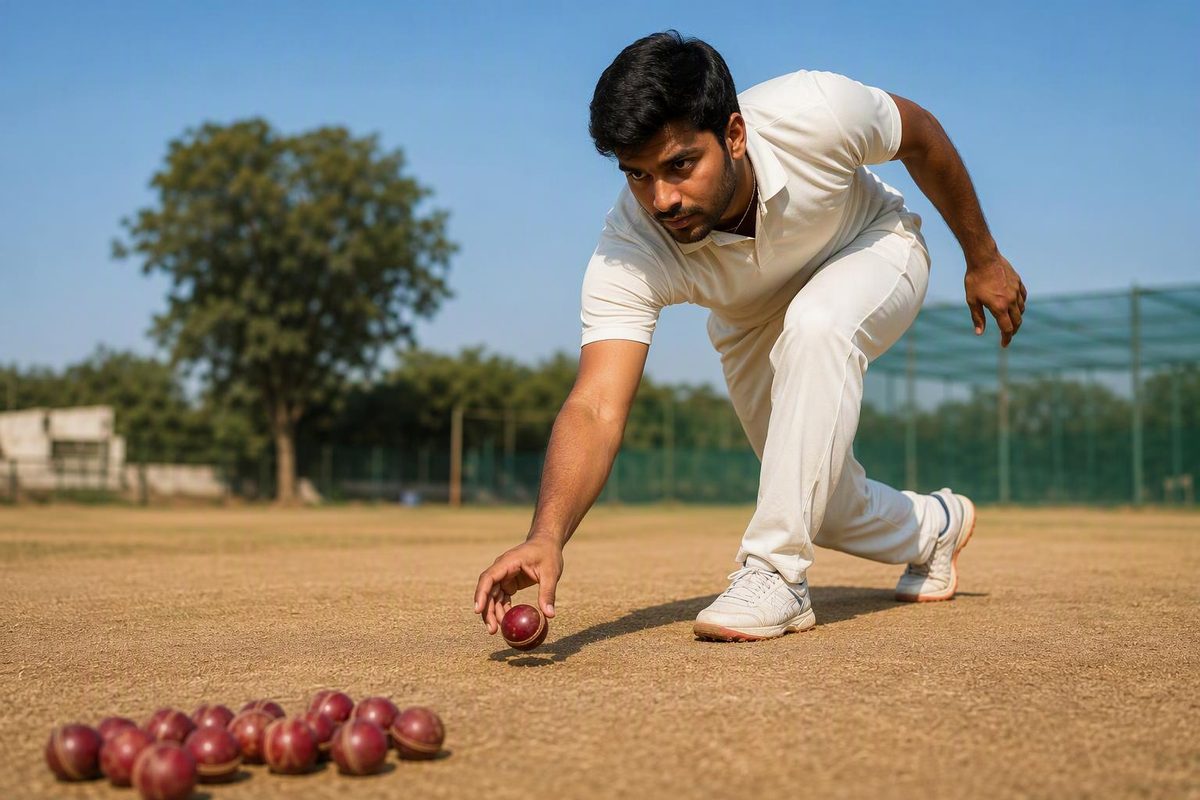
A carrom ball is a finger-flicked spin delivery: the bowler uses a bent middle finger to flick the ball out against the support of the thumb. Sky Sports’ introduction to Harbhajan Singh’s demonstration describes this mechanism. Your first practice goal is a clean, repeatable release—not a large amount of turn. Sky Sports’ carrom-ball explanation
For a right-arm off-spinner bowling to a right-handed batter, an away-turning carrom ball can contrast with the stock off-break, which turns towards the batter. But the name does not guarantee one direction: Cricbuzz describes how controlled carrom-ball releases can move either way. Record what yours actually does before calling it an away-turner. Cricbuzz’s account of Ashwin’s carrom ball
Grip: support the ball, then flick
Cricbuzz describes the ball held between thumb and index finger, with the middle finger bent behind it to supply the flick. Use that as your starting arrangement. Cricbuzz’s grip description
Try these comfort and release cues:
- Thumb: support the ball without clamping it hard.
- Index finger: steady the ball on the opposite side.
- Middle finger: bend it behind the ball so it has contact from which to flick.
- Ring and little fingers: keep them relaxed and clear enough not to trap the ball during release.
Do not force the middle finger into an extreme bend to imitate another bowler’s hand.
Begin with gentle releases from your bowling hand into your other hand, keeping both away from your face. Let the middle finger straighten and flick the ball free while the supporting fingers allow it to leave.
Release cue: “Support lightly; flick cleanly.”
Watch the seam for visible rotation. At this stage, you are checking whether the finger flick produces spin without the ball sticking, dropping or being pushed out with little rotation. Stop if you feel sharp finger or joint pain; have the grip checked in person rather than pushing through it.
A staged 36-ball practice drill
This suggested structure comprises 12 hand-to-hand releases and 24 bowled deliveries. The distances and checkpoints organise practice; they are not validated standards or promises of progress. Warm up with your usual bowling first. Use a clear net or practice lane without a batter while learning the release.
Block 1: 12 gentle release attempts
Flick the ball from hand to hand using the grip above. Keep the effort low enough to see what is happening.
Record a clean release only when the ball leaves without snagging and you can see rotation. A slow-motion phone clip may help; put the phone safely outside the ball’s path. If you cannot judge the rotation, mark the attempt unclear rather than counting it as clean.
If the ball repeatedly sticks or the grip is uncomfortable, repeat this block next session rather than adding bowling distance.
Block 2: 12 short-distance deliveries
Stand approximately 8–10 metres from a flat, one-metre-square landing target. Use your normal bowling-arm motion from a standing start, at comfortable effort. The short distance is for learning; do not treat the hand-to-hand flick as a substitute for a bowling action.
Keep the same grip and release cue. Record two separate scores:
- Clean releases: out of 12, using the same definition as Block 1. Use a safely positioned camera or an observer outside the ball’s path if needed.
- Target hits: first bounce inside the square, out of 12.
Do not sacrifice the flick simply to guide the ball onto the target. If clean rotation disappears, return to the gentle release work.
Block 3: 12 deliveries at your normal pitch distance
Try this exploratory block only if the short-distance release feels comfortable and repeatable. Use a short approach, your normal bowling action and the same target size. Otherwise, repeat Block 2.
Add a third observation: turn after pitching—left, right, straight or unclear, viewed from the bowler’s end. Judge the change from the ball’s incoming path, not simply where it finishes. Use the same surface throughout the comparison. One ball that turns sharply is not enough to establish a dependable variation.
A compact record might read:
Short approach | clean 9/12 | target 6/12 | left 5, right 0, straight 4, unclear 3
When to progress
Before moving from the short approach towards your full approach, use this working checkpoint: at least 8 clean releases and 6 target hits out of 12 at normal pitch distance in each of two sessions. Keep recording turn separately; hitting those scores does not establish a reliable away-turner.
Keep the carrom ball as a small part of your session while maintaining your stock delivery. Once the release and landing point hold together, alternate stock balls and carrom balls to check whether changing grips disrupts your rhythm. Use the spin-bowling accuracy drills if target control starts replacing clean spin.