
Cricket Training for Finger Spinners: Test One Release Cue
Use a 36-ball cricket training session to test one finger-spin release cue, record landing accuracy and decide what to practise next.
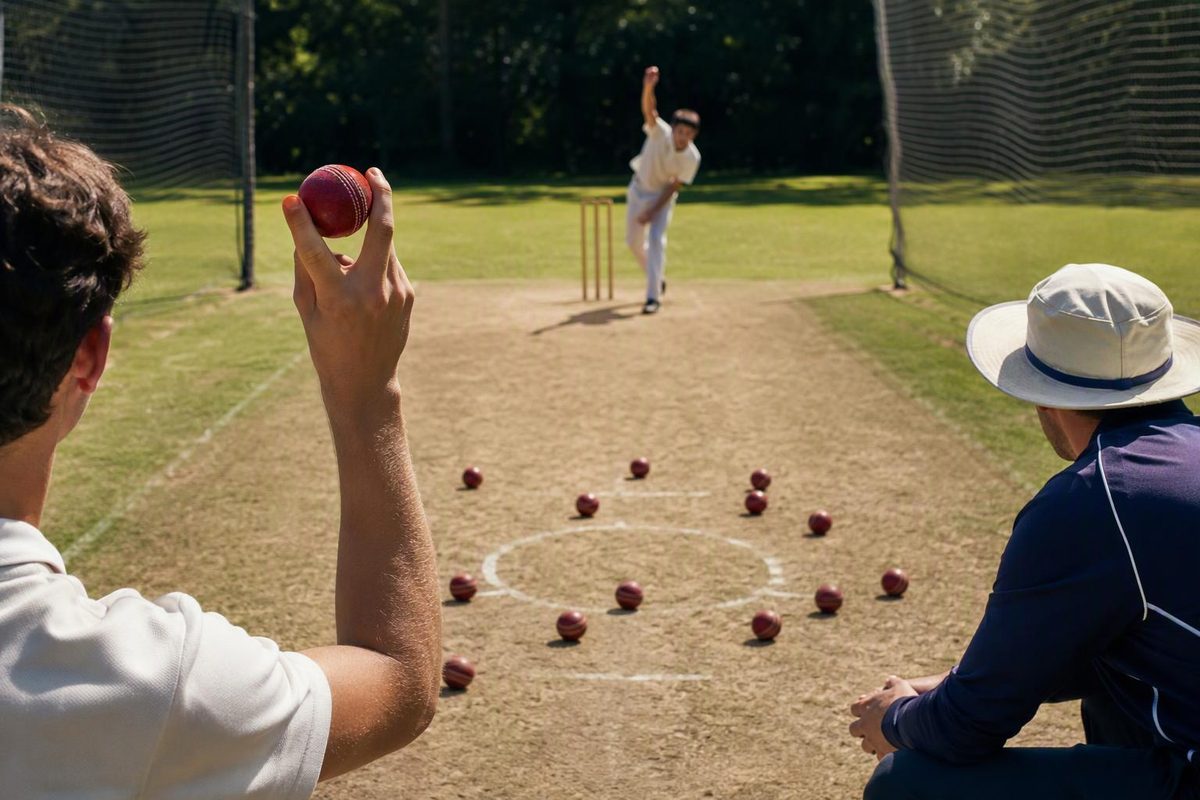
Give your next cricket training session one question: can you use a clear release cue without losing control of your stock ball? Your stock ball is the delivery you intend to bowl most often, not a variation.
This is a focused release check for right-arm off-break and left-arm orthodox bowlers who already have a stock-ball action. For a broader session, use the stock-ball practice plan. Wrist spinners should use their own release mechanics rather than copy the index-finger cue below; start with the beginner’s spin-bowling guide if you are unsure which type you bowl.
The 36 deliveries and checkpoints here are suggested practice rules, not universal coaching standards.
Set up one repeatable test
Use a clear net or practice lane, stumps, a ball appropriate to your cricket and flat markers permitted by the facility. Keep people out of the bowling lane. Start without a batter so you can observe where each delivery pitches.
- Distance: use the pitch length you normally play on. Juniors should use their competition’s length, not automatically an adult pitch.
- Target: mark a square roughly one metre by one metre around your intended landing point. Use a generous target initially; do not move it between blocks.
- Delivery: bowl your stock ball from your normal approach throughout.
- Record: note the pitch length, target location, ball and surface so you can repeat the setup.
Choose a landing point that suits your usual bowling plan, rather than copying a fixed distance from the batter’s stumps. If you cannot decide whether your problem is line or length, use the separate line-and-length drills first.
Warm up before starting: move comfortably, then build from easy releases to your normal bowling action. Rest between blocks. The 36 recorded balls are not a requirement to finish through pain or fatigue. Stop if bowling causes sharp joint pain.
Choose one release cue
For this session, use:
Feel the index finger brush down the seam as the ball leaves the hand.
In his finger-spin guidance, Peter Such describes an orthodox grip with the index and middle fingers spread on the seam, the ball held towards the ends of the fingers and ideally no thumb pressure. He identifies the index finger as the main contributor to spin and describes it coming over the ball and pulling down the seam. The cue above is a simplified reminder of that movement. (Peter Such’s finger-spin mechanics)
Use the cue within your existing action. Do not simultaneously change your grip, wrist angle, run-up and delivery stride. Such also stresses that the whole body contributes to spinning the ball; this is not an instruction to replace your bowling action with a finger flick. (Wisden’s interview with Peter Such)
Bowl three 12-ball blocks
Block 1: establish your baseline
Bowl 12 stock balls with your usual routine. Aim at the square, but do not deliberately introduce the new cue.
Record each attempt immediately. Count every delivery in the practice block, including an obvious error; otherwise your score will hide the misses.
Block 2: test the cue
Bowl another 12 at the same target. Before each delivery, remind yourself of the index-finger cue once, then bowl normally.
Alongside the landing result, record whether you felt clear finger contact at release: yes, no or unsure. This is a record of sensation, not a measurement of revolutions.
Block 3: check whether you can repeat it
If the cue felt comfortable, repeat it for 12 more balls without adding another instruction. If it caused discomfort or made the release feel forced, abandon it rather than completing a test at all costs.
Keep the target, approach and intended trajectory unchanged. You are checking repeatability, not trying a faster ball or a new variation.
Keep the scorecard simple
| Block | Target hits / 12 | Most common miss | Release note |
|---|---|---|---|
| Usual routine | Short, full, left or right | Usual feel | |
| Cue trial | Clear contact: __ / 12 | ||
| Cue repeat | Clear contact: __ / 12 |
Judge left and right from the bowler’s viewpoint. Count a hit when the first bounce lands inside the square or on its boundary. For misses, record the main direction; consistency matters more than elaborate notation.
You can note visible turn separately, but this test does not measure spin rate.
Decide what to practise next
Keep testing the cue if it feels comfortable and both cue blocks retain roughly your baseline accuracy. Repeat the session on another day before deciding it belongs in your match routine.
Simplify if release contact is unclear and misses scatter: try a few easy, short-distance releases next time before returning to your normal approach.
Do not stack corrections if one miss dominates. Keep that observation and work on it separately.
One better block does not establish lasting improvement. Your useful result is a repeatable setup, a recorded miss pattern and one clear decision for the next session.