
Find a Ball You Can Control From the First Frame to the Last
Start near 10% of body weight, check the fit, then test nearby weights through a full game for comfort, control, and repeatable form.
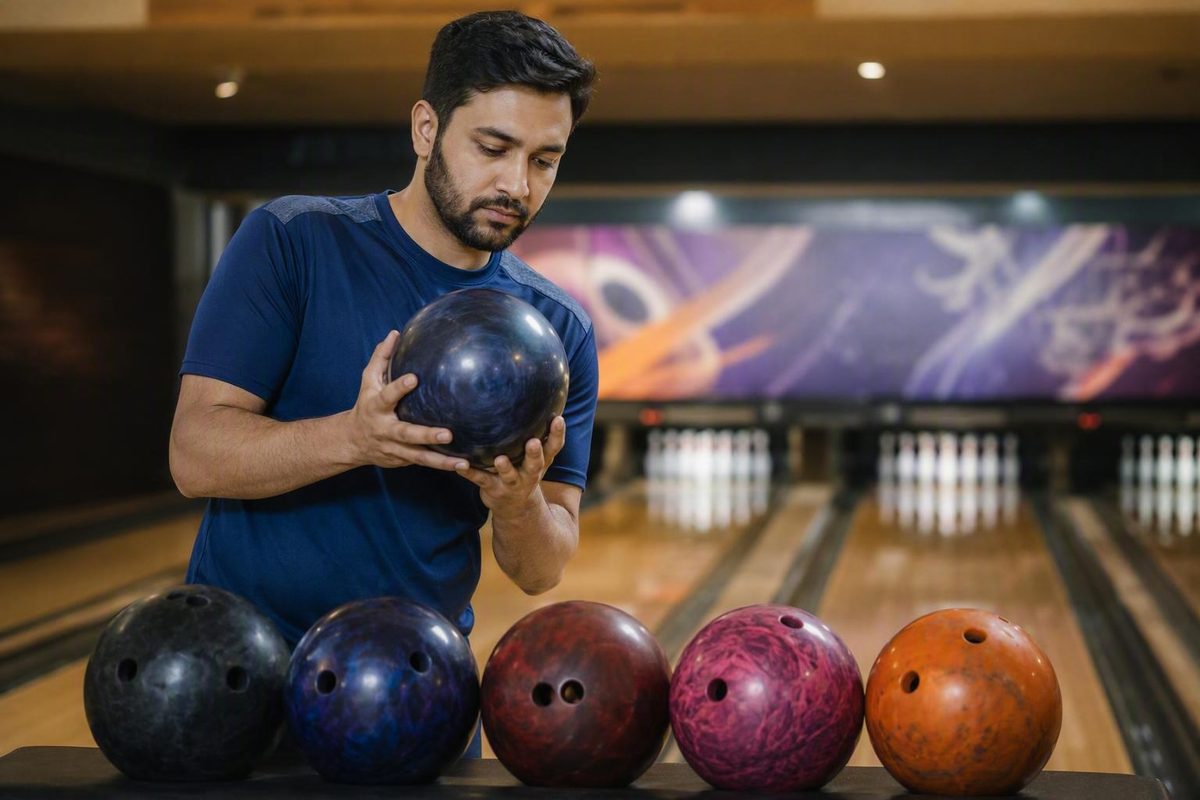
The short answer: start with an estimate, then let execution decide
For ten-pin bowling, the right bowling ball weight is the heaviest ball you can deliver comfortably, accurately, and with repeatable form throughout your intended session. You should be able to preserve balance, control, a consistent release, and reasonably consistent speed—not merely lift the ball or throw it well for a few frames.
Commercial selection guides commonly describe ten-pin balls as weighing roughly 6 to 16 pounds and suggest beginning near 10% of body weight. They also emphasize that comfort and control should override the calculation. Treat that formula as a practical convention, not a scientifically validated way to determine the safest or highest-scoring weight. Lucky Strike describes the 6–16-pound range and the 10% starting convention.
That produces a simple first estimate:
- A 120-pound bowler might begin by testing a 12-pound ball.
- A 150-pound bowler might begin around 15 pounds.
- A bowler whose calculation exceeds the equipment limit should not use the formula as a reason to seek a heavier ball.
- Anyone who finds the estimated weight uncomfortable should move lighter immediately.
Then test nearby weights. A 150-pound beginner might compare 14 and 15 pounds, adding 13 or 16 only when appropriate. The calculation selects the first ball to try; the quality of the delivery determines the final choice.
Do not let body weight, age, sex, or competitive level make that decision alone. Two bowlers of the same size can have different hand dimensions, strength, mobility, injury histories, techniques, workloads, and tolerance for fatigue. A ball that works for one recreational game may also become difficult during a longer league session.
A tertiary summary of USBC equipment specifications reports a 16-pound maximum for ten-pin balls. It also distinguishes ten-pin equipment from the smaller, different equipment used in candlepin, duckpin, five-pin, and some forms of nine-pin bowling. Because equipment rules can change, sanctioned competitors should confirm the current rule with the relevant governing body. The bowling-ball specification overview reports the USBC ten-pin limit and distinguishes other bowling disciplines.
The practical answer is therefore:
Start near 10% of body weight, check the fit, and choose the heaviest option that remains comfortable and repeatable from the first frame to the last.
A five-step lane test for choosing your weight
A chart cannot tell whether you squeeze the ball, lose balance at the line, or tire later in a session. A controlled lane test can reveal those problems.
1. Calculate a starting estimate
Multiply your body weight in pounds by 0.10 and round to an available ball weight. Treat the result only as the first candidate.
Examples:
- 90 pounds × 0.10 = 9 pounds
- 120 pounds × 0.10 = 12 pounds
- 150 pounds × 0.10 = 15 pounds
- 180 pounds × 0.10 = 18 pounds, so the formula has exceeded the reported ten-pin limit and should not be followed literally
Storm’s beginner guide also presents 10% as a starting point, emphasizes testing different weights, and notes that a bowler weighing 160 pounds or more does not necessarily need a 16-pound ball. Storm prioritizes comfort and control over strict adherence to the estimate.
If the estimated ball immediately causes discomfort, makes you brace your wrist, or pulls you off balance, stop testing that candidate and move lighter. There is no value in continuing with an obviously unsuitable weight.
2. Select at least two nearby weights
Compare at least two candidates. Testing in one-pound increments is a useful practical convention when those weights are available, although it is not a scientifically established requirement. BowlersMart likewise recommends gradual changes, generally one pound at a time. BowlersMart presents one-pound changes as practical fitting guidance.
If your estimate is 14 pounds, for example, start with 13 and 14. Add 15 only if 14 remains comfortable and controlled.
Whenever possible, compare balls with reasonably similar hole fit. A badly fitted 13-pound house ball and a well-fitted 14-pound ball do not provide a clean weight comparison.
Avoid changing after every delivery. Bowl enough shots with each candidate to settle into a normal approach and release. The objective is not to produce the best isolated shot; it is to find the ball with which ordinary shots remain sustainable.
3. Check fit before judging weight
Insert your thumb fully into the thumbhole. It should enter and exit readily without binding, but it should not be so loose that you must clamp down to retain the ball.
Next, check the span: the distance from the front edge of the thumbhole to the front edges of the finger holes. With the thumb seated, your hand should reach the finger holes without being stretched flat across the ball or bunched unnaturally. You should not need excessive grip pressure to hold it. Pin Chasers explains these thumb-clearance and span checks for house balls.
If a candidate fits badly, find another ball of the same weight before deciding that the weight itself is wrong.
4. Bowl at least a full game
A few practice shots can reveal obvious problems, but they may not expose fatigue. As a practical minimum, bowl a full game before making a preliminary decision. Commercial lane guidance similarly recommends testing weights during an actual game and judging whether form remains consistent throughout it. AMF recommends an in-game comparison rather than choosing by feel alone.
Compare the early and late frames:
- Is the swing still smooth?
- Has grip pressure increased?
- Is the ball beginning to drop at release?
- Are you leaning, standing up, or falling away to compensate?
- Has speed declined noticeably?
- Are misses growing larger or consistently moving in one direction?
- Has discomfort appeared?
One game is a useful trial, not a scientifically established universal test. If you plan to bowl several league or tournament games, test over a comparable workload. A ball that feels manageable for ten frames may not remain manageable over a longer block.
5. Compare execution, not just pinfall
Assess each candidate on:
- Balance: Can you finish at the foul line under control?
- Grip pressure: Can the hand remain relatively relaxed?
- Release timing: Does the ball leave the hand at the intended point?
- Speed consistency: Does speed remain reasonably stable later in the session?
- Target accuracy: Can you repeatedly send the ball over the intended board or arrow?
- Comfort: Is the delivery free of pain and increasing strain?
- Repeatability: Does the late-session shot resemble the early-session shot?
Do not choose solely by which ball produced more strikes in one game.
Use this decision rule:
- Move down one pound when discomfort develops or balance, speed, timing, accuracy, or release quality deteriorates.
- Consider testing one pound up only when the current ball remains easy to control for the full workload and you repeatedly overthrow it.
- Check fit and technique before changing weight when the symptoms are ambiguous.
Too heavy, too light, or simply a poor fit?
Weight, fit, and technique can create similar symptoms. Use this table as a prompt for further testing, not as a diagnosis.
| Possibly too heavy | Possibly too light | Possibly a poor fit |
|---|---|---|
| Swing feels forced or muscled | You repeatedly overthrow the ball | Thumbhole binds during release |
| Release becomes late | Timing feels rushed or disrupted | Thumbhole is so loose that you squeeze |
| Ball drops at release | Ball appears to deflect excessively | Span overstretches the hand |
| Balance deteriorates at the line | Carry appears weak despite accurate pocket contact | Fingers or thumb do not sit comfortably |
| Speed declines later in the session | You struggle to feel the ball in the swing | Hand and forearm remain excessively tense |
| Grip pressure increases | The ball is difficult to slow down | Release varies because the hand cannot relax |
| Fatigue or discomfort develops | Control suffers when you try to add power | One ball feels much worse than another of the same weight |
| Late-session accuracy worsens | Normal tempo feels unnaturally quick | You must alter hand position merely to retain the ball |
These signs are not conclusive. BowlersMart identifies forced swings, late releases, dropping, reduced speed, fatigue, and deteriorating late-session accuracy as possible signs of excessive weight. It lists overthrowing, deflection, and weak carry as possible signs of insufficient weight, but these are experience-based fitting observations rather than controlled diagnostic findings. BowlersMart outlines common heavy- and light-ball warning signs.
Change one variable at a time:
- Find a better-fitting ball at the same weight.
- Keep the basic delivery as consistent as possible.
- Observe whether the problem remains.
- Only then test a nearby weight.
Pain should not be used as a selection test. Storm’s guidance advises moving away from a weight that produces pain or discomfort rather than following the formula regardless. Storm places comfort ahead of the weight convention.
If pain persists, or if bowling is associated with numbness, weakness, postsurgical symptoms, or aggravation of an existing condition, stop and seek appropriately qualified healthcare guidance. This is a conservative safety boundary, not a diagnosis.
House balls and fitted balls are not an equal comparison
A house ball must serve many people. Its holes come in generalized combinations of thumb size, finger size, and span, so the number stamped on the ball tells you its total weight—not whether it fits your hand.
That distinction matters because the hand must retain the ball during the swing and release it cleanly. If the thumbhole is too loose, you may squeeze. If it is too tight, the thumb may bind. If the span is too long, the hand may become stretched and tense. Any of these problems can make a relatively light ball feel demanding.
For a basic house-ball fit check:
- Insert the thumb fully.
- Confirm that it slides in and out without sticking.
- Reject a hole so loose that you must clamp down.
- With the thumb seated, place the fingers over or into their holes.
- Check that the hand is neither overstretched nor cramped.
- Hold the ball securely without squeezing hard.
Span is the distance from the front edge of the thumbhole to the front edges of the finger holes. It is only one part of fitting, but it helps explain why two house balls with the same marked weight can feel very different.
Custom drilling places the holes for an individual hand and grip. In an instructional video, professional bowler Mike Rhodes explains that house balls use generalized drilling and recommends consulting a bowling professional who can observe the delivery before selecting a first fitted ball. Rhodes discusses the difference between generalized house drilling and an individually fitted ball.
A fitted ball may feel more manageable than a poorly matched house ball because the bowler may not need as much compensatory grip pressure. That does not mean every bowler can safely add one or two pounds after custom fitting. Physical capacity, technique, workload, and health still determine whether a weight is sustainable.
Use house balls to identify an approximate range. Before buying, consult a qualified pro-shop fitter who can measure the hand, discuss grip style, and observe the delivery. Test the proposed weight rather than assuming that a comfortable 14-pound house ball translates directly to every 14- or 15-pound fitted performance ball.
Starting points for beginners, youth, seniors, and different physical needs
Published selection charts disagree. Some divide bowlers by age, sex, body weight, or skill; their methods are generally not validated or fully explained. Treat demographic ranges as broad trial ranges, not prescriptions.
Across the supplied commercial guides, youth recommendations broadly occupy the 6–14-pound range, depending on age, hand size, coordination, and strength. Adult beginners are directed toward portions of an approximately 10–16-pound range, but that span is far too broad to answer an individual fitting question by itself. AMF provides broad category ranges while still prioritizing comfort and control.
Beginners
A beginner should learn a controlled, balanced delivery at a sustainable weight before considering an increase. The ball should be heavy enough to swing naturally without being forced by the upper body, but light enough to repeat the motion through the intended session.
Begin near the body-weight estimate, compare nearby weights, and favor the lighter option if the heavier candidate causes gripping, rushing, muscling, or balance loss. Improving fit or delivery may be more useful than moving up.
Children and teenagers
Do not rely on a “one pound per year of age” shortcut. Age alone cannot reveal hand size, coordination, maturity, strength, or whether the holes fit.
For a young bowler, prioritize:
- Thumbhole and span fit
- The ability to retain the ball without squeezing
- Balance during the approach and finish
- A smooth delivery rather than a heave
- Supervision around the return and lane
- Repeatability without discomfort or visible strain
Dropping the ball, twisting abruptly, or repeatedly losing balance should prompt a lighter test ball and an in-person fit or technique check. These observations do not identify the cause by themselves.
Older adults and adaptive bowlers
Current capability matters more than what someone used in the past. Changes in mobility, endurance, grip, balance, or health may make a lighter ball the more controllable choice, even for an experienced bowler.
The same principle applies to adaptive bowlers: choose around the person’s present delivery, assistance, workload, comfort, and control. A heavier number has no intrinsic merit when it requires compensation.
Anyone with relevant wrist, elbow, shoulder, back, surgical, or other health concerns should seek individualized input from an appropriately qualified clinician and an experienced equipment professional. The clinician addresses health limitations; the fitter addresses grip and drilling. Neither role substitutes for the other.
Two-handed bowlers
Two-handed and thumb-free styles change how the ball is supported and how torque and revolutions are applied, but the supplied evidence does not establish a validated style-specific ideal weight.
Use the same test: comfort, control, balance, timing, and repeatability over the full intended session. Do not assume that using two hands automatically justifies a heavier ball—or that generating more revolutions requires a lighter one.
14 vs. 15 vs. 16 pounds: choose repeatability, not prestige
Fourteen, 15, and 16 pounds can all be viable adult bowling ball weights. There is no universal winner.
| Weight | Worth testing when… | Main caution |
|---|---|---|
| 14 lb | 15 or 16 causes fatigue, discomfort, forced motion, reduced speed, or loss of control | The change may alter speed, timing, release, and breakpoint |
| 15 lb | You want a middle option that remains sustainable over several games | Its frequent recommendation does not prove it is best for you |
| 16 lb | You can maintain relaxed, accurate mechanics throughout the workload | Being at the upper end does not make it a performance target |
When 14 pounds makes sense
Test 14 pounds when 15 or 16 produces discomfort, fatigue, gripping, poor balance, or late-session inconsistency. It may also suit a bowler who simply executes better with it.
Do not treat moving down as failure or assume it must reduce scoring. The useful comparison is between a repeatable 14-pound shot and a compromised heavier shot.
A lighter ball may initially travel faster, come off the hand differently, or reach its breakpoint elsewhere. Tempo, release, feet, or target may need adjustment. Evaluate the change over several sessions rather than treating the first game as a verdict.
When 15 pounds makes sense
Commercial and coaching-oriented guides often present 15 pounds as a compromise between control and heavier equipment. That makes it reasonable to include in a test; it does not establish 15 pounds as the professional standard or the best choice for most adults.
Choose 15 pounds if it preserves the delivery over your actual workload. Reject it if 14 provides clearly better comfort and repeatability, or if 16 is equally controlled and better suited to your game.
When 16 pounds makes sense
Sixteen pounds is appropriate only when the bowler can sustain it without muscling the swing, squeezing, losing speed, falling away from the shot, or developing discomfort. The fact that it sits at the upper end of ten-pin equipment does not make it a goal.
A heavier ball does not automatically create more strikes, hook, carry, or higher scores. Those outcomes depend on the delivery, ball design, fit, and lane environment.
A third-party comparison argues that 14-, 15-, and 16-pound balls can carry similarly, but it does not identify or present the controlled studies it invokes. Treat that carry claim as unproven. Its more useful observation is that a change in weight can coincide with changes in speed, revolutions, timing, and exact equipment specifications. ZVL Bowling discusses practical differences among the three weights.
Track delivery quality and discomfort over several sessions. One unusually good or bad game cannot separate weight effects from lane conditions, execution, and ordinary scoring variation.
Weight is only one part of ball reaction
A bowling ball does not react because of total weight alone. Reaction emerges from the interaction of:
- Ball speed
- Rev rate
- Axis rotation and tilt
- Coverstock material
- Coverstock surface
- Core design
- Drilling and layout
- Grip style and fit
- Lane oil and transition
- Release location and execution
Polyester, urethane, and reactive-resin coverstocks differ in traction characteristics. If a new ball hooks more or less than an old one, the weight change may not be the primary cause.
Grip style matters as well. In a conventional grip, the fingers generally insert farther than in a fingertip grip. Fingertip and thumb-free two-handed releases can change how a bowler applies torque and creates revolutions. These differences make simple claims such as “heavier means more hook” unreliable.
Check specifications at the exact weight
Different weights of the same named model may not use identical internal components or mass properties. Before purchasing, inspect the manufacturer’s current specification table for the exact weight and compare:
- Core type or shape
- RG, or radius of gyration
- Differential
- Intermediate differential, where applicable
- Coverstock and factory surface
Do not treat RG or differential as scores of quality.
A third-party comparison reports different exact-weight specifications for selected Storm Hy-Road and Equinox balls. Because the video is not a current manufacturer specification sheet, those examples should be used only to illustrate the need to check exact-weight data—not as purchase specifications or a pattern that can be generalized to other models.
Whenever possible, use the manufacturer’s current product page or specification sheet rather than a retailer filter, an old video, or the data for a different weight. A lighter version may not be a direct substitute for your current ball even when the name and coverstock appear the same.
Treat weight selection and reaction selection as related but separate decisions:
- Choose a weight your body and delivery can sustain.
- Choose a design suited to your release and lane environment.
- Have the ball fitted and drilled appropriately.
- Adjust surface and targeting with qualified guidance as needed.
When to change weight—and how to make the transition
Move down when a heavier ball continues to cause discomfort, fatigue, reduced speed, poor balance, forced mechanics, dropping, gripping, or late-session inaccuracy after you have checked the fit. A one-pound reduction is often the cleanest practical comparison, although it is not a medically or scientifically validated threshold.
Consider moving up only when all of the following are true:
- The current ball remains comfortable through the full intended workload.
- Mechanics and balance remain stable.
- You can release the ball without squeezing.
- You repeatedly overthrow it despite working on tempo.
- A fit or technique correction does not resolve the problem.
Even then, test before buying. Overthrowing can reflect rushed feet, an overly forceful swing, poor fit, or a ball-reaction mismatch—not insufficient weight.
What to track after changing weight
Use several sessions and keep brief notes on:
- Speed early and late in the session
- Approach and swing timing
- Balance at the foul line
- Grip pressure
- Target accuracy
- Breakpoint location
- Shape downlane
- Comfort during and after bowling
- Consistency in later frames or games
A lighter ball may initially travel faster or change release timing. It may reach a different breakpoint or respond differently to friction, especially when the new ball’s core and surface differ from those of the old ball. Starting position, target, tempo, or release feel may need adjustment.
Forum participants have reported maintaining or improving their scoring after moving from 16 to 15 pounds or from 15 to 14, while others described an adjustment period. These anecdotes show only that a score collapse is not inevitable; they do not prove that lower weight caused an improvement. BallReviews forum participants describe varied experiences after reducing weight.
When purchasing at a new weight, reassess both fit and exact-model specifications. Do not duplicate the old drilling from memory or assume that the internal construction is identical across weights. Ask the fitter to confirm measurements and explain any exact-weight differences.
The complete decision flow is:
- Estimate: Use roughly 10% of body weight only to select a first test ball.
- Fit: Check the thumbhole, finger holes, and span.
- Test: Bowl long enough to expose fatigue or deteriorating form.
- Diagnose: Separate weight concerns from fit, technique, design, and lane conditions.
- Adjust: Change by one pound when practical.
- Retest: Compare comfort and execution over your real workload.
Select the heaviest ball that keeps your delivery comfortable and repeatable—not the heaviest ball you can lift and not the weight another bowler says you should use. Before buying, obtain an individual fitting and check the manufacturer’s specifications for the exact weight.
If bowling produces persistent pain, numbness, or weakness, stop and seek qualified healthcare guidance rather than trying to solve the problem through equipment changes alone.
Editorial note: Spin Bowling Tips primarily publishes about cricket spin bowling. This ten-pin article synthesizes third-party selection and fitting guidance as a separate subject-area resource. It does not represent ten-pin coaching, pro-shop fitting, medical expertise, or a transfer of the site’s cricket expertise to ten-pin bowling.
Frequently asked questions
Is 10% of body weight the correct bowling ball weight?
No. It is a starting estimate, not a scientifically validated prescription.
A 120-pound bowler might begin near 12 pounds, while a 150-pound bowler might begin near 15. Either should test nearby weights and move lighter if the estimate causes discomfort, loss of balance, gripping, or deteriorating execution.
Is a 16-pound bowling ball the legal maximum?
A tertiary summary of USBC equipment specifications reports 16 pounds as the maximum for a ten-pin bowling ball. Competitors should confirm the current governing-body rule for their event because rules can change. The cited specification overview reports the USBC ten-pin maximum.
Do not generalize that ceiling to candlepin, duckpin, five-pin, nine-pin, or other bowling disciplines.
Can a fitted 15-pound ball feel easier than a 14-pound house ball?
Yes. A house ball’s generalized thumbhole and span may force you to squeeze or overstretch the hand, while a fitted ball places the holes for the individual bowler.
That does not guarantee that a heavier fitted ball will be suitable. Test it over the intended workload and judge comfort, balance, release quality, and late-session consistency.
Will switching from 16 to 15 or 14 pounds hurt my scores?
Not necessarily. Some bowlers report maintaining or improving scores after moving lighter, but those reports are anecdotal and do not predict what will happen in another bowler’s game.
Expect possible changes in speed, timing, revolutions, breakpoint, and targeting. Evaluate several sessions and compare the manufacturer’s exact-weight specifications before attributing a scoring change to weight alone.
What should I do if bowling causes wrist, elbow, or shoulder pain?
Stop rather than using pain as part of the weight test. Check the ball’s fit, and do not continue merely to prove that you can handle a particular weight.
For persistent pain, numbness, weakness, postsurgical symptoms, or aggravation of an existing condition, seek an appropriately qualified healthcare professional. A pro-shop fitter can assess equipment fit but should not diagnose or treat a medical condition.