
What a Keeper Can—and Cannot—Do in Front of the Stumps
From 1 October, gloves may be in front during the run-up, but the keeper must be wholly behind the striker’s wicket after release.
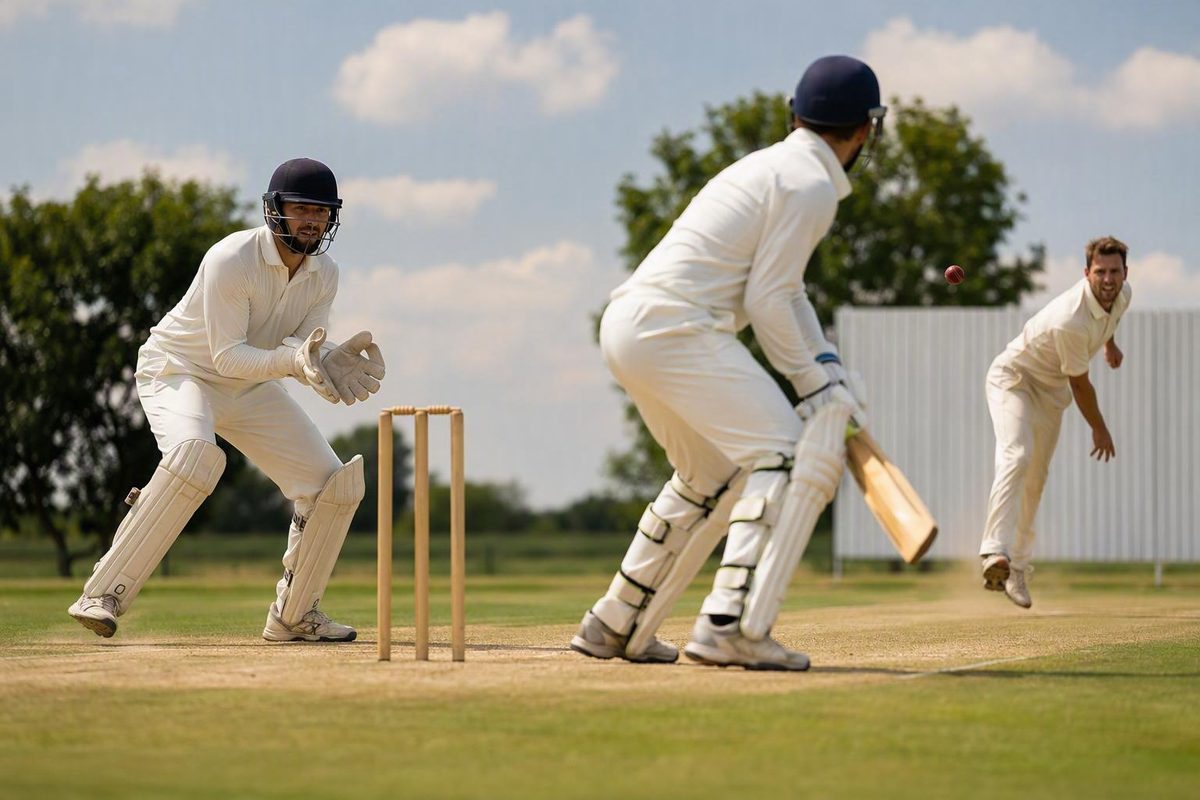
From 1 October 2026, revised Law 27.3.1 permits a wicketkeeper’s gloves to be in front of the stumps during the bowler’s run-up. Only after the ball has been released must the wicketkeeper be wholly behind the striker’s wicket, according to MCC’s official summary of the 2026 Law changes.
This is limited pre-release leeway. It does not require the keeper to stand up, permit the keeper to remain in front during the post-release stage, or remove the separate restriction on significant and unfair wicketkeeper movement. MCC announced the fourth edition of the 2017 Code in February 2026, but its 73 changes take effect on 1 October 2026, not on the announcement date (MCC announcement).
The short answer: what changes on 1 October 2026
Under the revised position rule, a keeper standing close may let the gloves project in front of the stumps while the bowler runs in. A forward glove position during that phase does not, by itself, breach revised Law 27.3.1. After the ball has been released, the keeper must be wholly behind the striker’s wicket.
The amendment therefore changes when the wholly-behind requirement applies. It does not say that a keeper must stand close, and it does not turn “standing up” into a new legal category. Position, movement and interference remain separate considerations under Law 27.
The commencement date is important because publication and implementation are not the same thing. MCC released the new edition early so players, umpires and governing bodies would have time to learn the revised wording before it came into force.
Date check
Before 1 October 2026: apply the earlier Law 27 unless the competition’s adopted playing conditions expressly provide otherwise. From 1 October 2026: verify that the competition has adopted the 2026 edition, then apply that edition together with its playing conditions.
That final check matters at club level. MCC’s general commencement date does not remove the need to confirm which Laws and playing conditions a particular league, cup or governing body has adopted.
Run-up, release and delivery: the rule on a simple timeline
“Standing up” is too imprecise for a close decision. For practice and match discussion, divide the action into three stages. The distinctions below follow MCC’s formulation that the gloves may be in front during the run-up and that the keeper must be wholly behind only after release (MCC Law-change summary).
-
During the run-up: The keeper does not breach revised Law 27.3.1 merely because the gloves are in front of the stumps. The published summary specifically identifies the gloves. It should not be expanded into a general claim that every body part or item of equipment may cross the stump line.
-
Around the release transition: The keeper must organise the stance and movement so that the required wholly-behind position applies for the post-release stage. In training, rehearse the complete legal position rather than concentrating only on moving the gloves.
-
After release: The amendment does not authorise the keeper to remain level with or in front of the striker’s wicket. The keeper must be wholly behind.
Do not treat “at release,” “after release” and “for the delivery” as automatically interchangeable legal tests. Summaries of the amendment have used different expressions. If a glove or another part of the keeper is close to the stump line at the release transition, the complete operative Law and the umpire’s judgement govern the decision.
For that reason, a club keeper should not build the tactic around an attempt to beat the release instant by a fraction. The practical aim is a repeatable position that avoids a marginal call altogether.
Old and new Law 27 compared
The 2026 changes address two distinct questions:
- Law 27.3.1: Where must the wicketkeeper be positioned?
- Law 27.4.1.1: When does the keeper’s movement become significant?
The pre-October Law 27 displayed by MCC requires the wicketkeeper to remain wholly behind the striker’s wicket from when the ball comes into play until one of the specified later events. That makes the earlier restriction applicable during the bowler’s run-up.
| Clause | Before 1 October 2026 | From 1 October 2026 |
|---|---|---|
| Law 27.3.1: position | Keeper wholly behind the striker’s wicket from when the ball comes into play, extending the restriction through the run-up | Wholly-behind requirement applies only after release; the gloves may be in front during the run-up |
| Law 27.4.1.1: movement | Forward-movement exception refers to a few paces for a slower delivery, unless this brings the keeper within reach of the wicket | Slower-delivery qualification removed; movement bringing the keeper within reach of the wicket is significant without that qualification |
The second row is not an extension of the first. Permission for the gloves to occupy a forward position during the run-up does not cancel the rule on significant movement. Nor does compliance with the basic position requirement prevent a separate issue involving unfair movement or interference with the striker.
That distinction is useful when discussing a close keeper. A static or nearly static glove position during the run-up raises the revised position question. A keeper advancing from farther back towards the wicket raises a movement question as well. The facts and the applicable clauses should be considered separately.
Three practical examples for bowlers, keepers and captains
The following examples apply the position and movement rules separately. They are guides to identifying the relevant issue, not promises about how an umpire will decide a marginal release transition.
| Phase | Keeper action | Likely status under revised wording | Clause |
|---|---|---|---|
| Run-up and post-release stage | Standing close to a spinner, the keeper’s gloves project forward during the run-up, but the keeper is wholly behind after release | Permitted from 1 October 2026 | Law 27.3.1 |
| After release | The keeper remains level with or ahead of the striker’s wicket | Not permitted by the amendment | Law 27.3.1 |
| Before the ball reaches the striker | The keeper begins farther back and advances until within reach of the wicket | Potentially significant movement; no longer dependent on a slower-delivery qualification | Law 27.4.1.1 |
The first example is the narrow situation accommodated by the amendment. It should not be interpreted as permission for a late, improvised scramble behind the wicket on every ball. If the timing is so close that players disagree about whether the required position had applied after release, the operative wording and the umpire’s judgement decide the matter.
The third example is different. “Within reach of the wicket” is the relevant test, but MCC’s change summary does not prescribe a universal distance in centimetres, shoe lengths or bat lengths. A team should not invent such a measurement and treat it as Law. Consider the keeper’s starting position, the amount and direction of movement, and the final relationship to the wicket as separate facts.
Match checklist
- Agree the intended starting position with the keeper, bowler and captain.
- Rehearse achieving the complete wholly-behind position, not merely pulling the gloves back.
- Distinguish a forward glove position during the run-up from an advance towards the wicket.
- Do not base the tactic on a marginal interpretation of the release transition.
- Check which edition of the Laws and which playing conditions the competition has adopted.
- Ask the umpires before play if the intended setup may create avoidable uncertainty.
Standing up is an old tactic, not a new requirement
The revised Law neither requires wicketkeepers to stand up nor makes the tactic legal for the first time. “Standing up” is informal tactical language. Law 27 instead considers the keeper’s position and movement relative to the striker’s wicket.
Those are tactical possibilities, not guaranteed outcomes, and the amendment does not alter the need to satisfy the relevant dismissal requirements.
Standing up has also long been used against seam bowling. Its renewed prominence in the 2026 English season was described as the return of an old tactic, separate from the Law amendment. The tactical reasoning is similar: keeping the batter closer to the crease may encourage fuller bowling and increase pressure around the stumps and outside edge.
That does not prove the tactic causes better bowling figures or more wickets. Match returns can show that a method was used during a successful spell, but they cannot establish by themselves that the keeper’s position caused the success.
For a club side, the decision remains practical. The keeper and bowler must judge whether the position is repeatable enough to use without creating avoidable errors or marginal legal questions. Nothing in the amendment obliges a side to try it.
What can be said about penalties—and what still needs confirmation
Positioning under Law 27.3 and unfair movement under Law 27.4 must remain separate when discussing sanctions.
- Law 27.3 concerns position. Under the displayed pre-October wording, contravention of the wholly-behind requirement results in the striker’s-end umpire calling and signalling No ball.
- Law 27.4 concerns unfair movement. Under that same pre-revision text, unfair wicketkeeper movement results in Dead ball and five penalty runs to the batting side, together with the specified notification and reporting procedure (displayed pre-October Law 27).
Those are the consequences stated in the earlier Law displayed by MCC. The published 2026 change summary establishes the revised position rule and the removal of the slower-delivery qualification from Law 27.4.1.1, but it does not reproduce every connected enforcement provision.
Accordingly, officials should not assume from the summary alone that every breach of the revised provisions automatically attracts a particular sanction or that every earlier procedural step remains unchanged. After commencement, the complete 2026 Law 27 and the competition’s adopted playing conditions provide the definitive basis for a ruling.
The usable coaching rule is narrow: from 1 October 2026, the gloves may be in front during the bowler’s run-up, but the wicketkeeper must be wholly behind the striker’s wicket after the ball has been released. Standing up remains optional, and significant movement remains a separate Law 27 question.