
Analyse Your Spin-Bowling Action, Phase by Phase
Film your stock ball, compare each phase of your bowling action and test one cue against a landing target—with a simple scorecard.
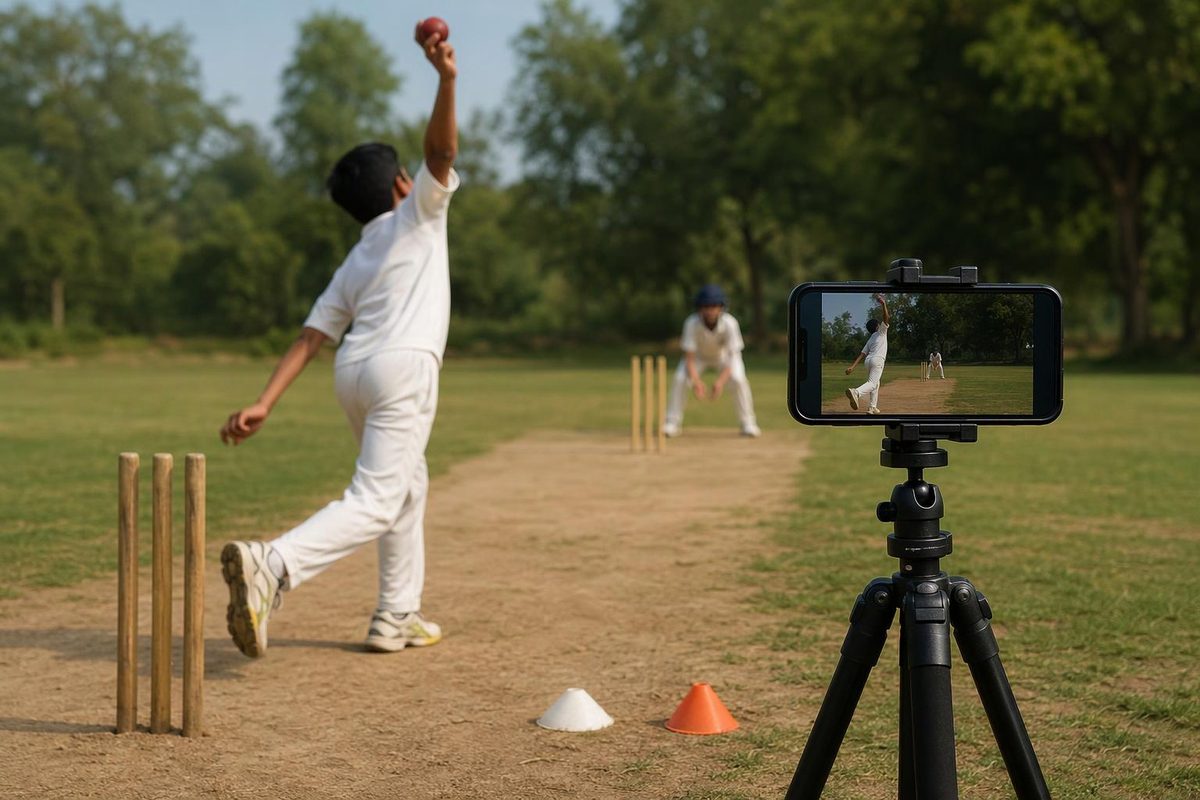
Analyse your action by comparing successful deliveries with repeated misses—not by copying a professional’s pose. For a self-coached spinner, the useful question is: what changes in my movement when the ball misses its target?
This checklist takes you from approach to follow-through, then helps you choose one change to test. Use your stock ball—the delivery you normally rely on—rather than mixing in variations.
Film an action you can compare
After warming up, mark a generous landing rectangle, such as 1 metre long by 1 metre wide, at your intended line and length. Use flat markers outside the landing area. Keep the ball, surface, bowling side and intended pace unchanged.
Record six deliveries from each view:
- Side-on: position the phone square to the delivery area, outside the bowling lane. Include the final approach steps, both feet, the raised bowling hand and the first follow-through steps.
- Behind the bowler: film towards the target from a safe position clear of the run-up. Keep the whole body and crease visible.
With one phone, these are separate six-ball blocks; do not treat clips from different views as the same delivery. Keep each camera position fixed for later comparisons. Use slow motion if available, but watch at normal speed first to judge rhythm.
Number the deliveries. For each, record hit, short, full, left or right, viewed from the bowler’s end; combine labels when necessary. If the target is difficult to see on video, ask a partner to record the landing result. Total your hits out of 12 and count each type of miss: these are your baseline scores. The line-and-length drill offers a more detailed scoring method.
Review the action in sequence
Wiltshire CCC’s coaching framework divides bowling into run-up, bound, foot contacts and follow-through. For this review, also isolate ball release so you can connect earlier movement with the final delivery. Wiltshire CCC: alignment
Within each camera view, start with two target hits and two examples of your most frequent miss, where available. Watch the complete clips, then pause at matching events—not matching timestamps.
| Phase | What to compare | What to write down |
|---|---|---|
| Approach | Final steps, rhythm and direction into the crease | Does the same extra shuffle, acceleration or sideways step appear on misses? |
| Gather or bound | Transition from approach into delivery; head and arm positions | Is there a repeated pause, rushed movement or sideways displacement? |
| Back-foot contact | Rear-foot landing at the start of the delivery stride; foot placement and hip/shoulder orientation | Does the rear foot land somewhere different on misses? |
| Front-foot contact | Front-foot landing, delivery-stride length and movement of the head and trunk | Is the stride visibly longer, shorter or farther across on those balls? |
| Release | Last frame with the ball in the hand and first frame after it leaves, if visible | Does the hand’s release position or trunk lean differ consistently? |
| Follow-through | Continued rotation, first steps and recovery | Do you finish freely and ready to field, or repeatedly stumble or stop abruptly? |
If the release is blurred or hidden, mark it as unclear rather than guessing.
These are observations to investigate, not automatic faults. Liam Sanders’s research on elite finger spinners describes substantial variation in foot orientation and body rotation across these phases. It also shows that movement continues after release; the release frame alone does not describe the whole action. Sanders: finger-spin bowling action, Chapter 4
Do not force a locked front knee, a perfectly vertical arm or a particular foot angle merely to improve a still image. A study of 23 district-level off-spinners and 15 leg-spinners found differences between the groups, including stride length and trunk movement. Finger-spin and wrist-spin need not share one template. Beach, Ferdinands and Sinclair: spin-bowling technique comparison
Find the earliest repeatable difference
Read your notes from approach towards follow-through. If a rushed final approach step appears before a changed front-foot landing and release position, investigate the approach first rather than trying to correct all three.
For example, you might record:
“Three full misses had a visibly longer delivery stride, from back-foot to front-foot landing; the target hits did not.”
That is a working hypothesis, not proof that stride length caused the misses. Check other deliveries for counterexamples. If the same longer stride also appears on good balls, it may not be the useful distinction.
A stumble after release can be a clue about the preceding movement, but changing the finishing pose alone is not a diagnosis.
Test one cue against the target
Choose a cue tied to the clearest observation. Examples include “same final-step rhythm” for a repeated rushed approach, or “same comfortable stride” when you repeatedly reach farther on misses. Avoid changing grip, run-up and arm path together.
Bowl another six balls from each camera position, using the same target and normal stock-ball intent. Compare with your baseline:
- Target hits out of 12.
- Number of misses in your main error category.
- Whether the selected movement became more consistent.
- Whether you had to reduce bowling intent to achieve it.
Keep the cue provisionally only if the intended movement changes without making control worse or requiring a gentler delivery. Repeat the comparison at your next session before adopting it. This is a practical test, not a validated pass mark.
Know when video is not enough
Use phone footage for visible patterns, not precise three-dimensional joint measurements or a verdict on legality. The ICC defines an illegal action as elbow extension of more than 15 degrees between the arm reaching horizontal and ball release. Its international process uses expert testing at accredited centres—not simply whether an elbow looks bent in a photograph. ICC: illegal bowling actions
If legality is questioned, take the clips to a qualified coach and follow your competition’s review process. Stop if bowling causes pain and seek appropriate assessment rather than experimenting through it.
Your useful result is one clear note: the recurring miss, the earliest visible difference and the cue you will retest. If no consistent difference emerges, keep the footage and scorecard for a coach instead of inventing a fault.